
Public Lecture | Caste-based Segregation in Urban India by Deepak Malghan | 13 August 2026
Conference Hall, Ground Floor, Training Centre
Thursday, August 13, 2026, 4:15 pm
Open to the public.
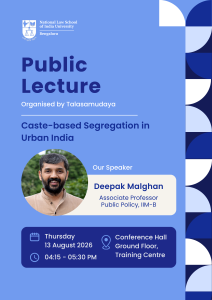 The National Law School of India University (NLSIU), Bengaluru, and Talasamudaya is organising a public lecture on “Caste-based Segregation in Urban India” by Prof. Deepak Malghan on 13 August 2026 from 4:15 PM to 5:30 PM in the Conference Hall, Ground Floor Training Centre, NLSIU.
About the Lecture
Urban India is characterised by a high degree of intra-city spatial inequality in the availability of public services like piped water and sewerage. We unpack the political channels that link residential segregation with access to public services. ‘Micro-segregation’, or neighbourhood residential sorting within a ward (the elementary administrative and political unit in urban India), enables segregated neighbourhoods to better organise and petition public services. Political competition further amplifies these demands from segregated neighbourhoods. The state’s response to such demand is, however, modulated by both in-group favouritism and outgroup discrimination. States’ ability to indulge in such favouritism and discrimination is in turn contingent on how the caste composition of a ward is different from that of the city as a whole –‘macro-segregation’.
This talk sheds light on how caste continues to shape patterns of residential segregation in urban India and caste-based inequalities are reproduced through urban governance and public policy. From the talk, one will be able to critically engage with contemporary research on caste, spatial inequality, and state capacity in India.
Profile of Speaker
Deepak Malghan is a chemical engineer and ecological economist at the interface of thermodynamics and scale theory. Among other recognitions for his contributions to scale theory, Malghan received the 2015 VKRV Rao Prize in Social Sciences and the 2023 T N Khoshoo Memorial Award. Malghan was an editor at the field’s flagship, Ecological Economics (2018-26), where he is now on the editorial board.
Malghan is an affiliated researcher at the Stockholm Environment Institute, where he conducts translational research on urban hydrology. Beyond ecological economics, Malghan’s Ecological Political Economy group at IIMB has pioneered new methods for characterizing ethnic inequality and stratification by combining tools and insights from economics, demography, and political science. His current projects apply these methods to study classical and emerging problems in ethnic politics and environmental injustice.
As a historian, Malghan is the co-author of an intellectual biography of J. C. Kumarappa (1892-160), a pioneering Indian ecological thinker and political philosopher (Oxford University Press, 2016). He is currently working on a book project (Citius, Altius, Fortius: A History of How the World Became Efficient) that develops the global history of the modern idea of efficiency.