
Guest Lecture by Nachiket Chanchani | Bird Artists Confront Partition | 6 July 2026
Moot Court Hall, OAB, NLSIU
This lecture is open to the public. Register here.
Monday, July 6, 2026, 5:00 pm
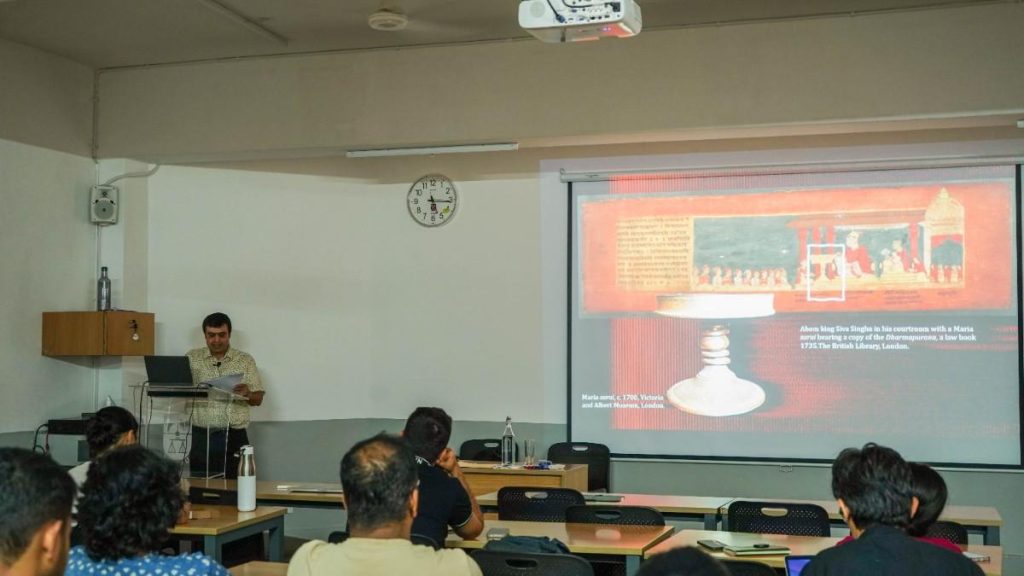
Bird Artists Confront Partition
Nachiket Chanchani
Associate Professor of the History of Art, University of Michigan, Ann Arbor, USA
This lecture is open to the public. Please register here.
Abstract
Historians have sometimes tended to present hand-wrought vessels as either the work of celebrated masters or of unknown craftsmen continuing age-old ways of making things. Such romantic notions have paid less attention to the political struggles that cooking utensils have been enmeshed in, discounted the qualities of materials that these objects are crafted from, and overlooked the role of other creative agents in their production. In this paper, Nachiket Chanchani, first melds the material record and textual evidence preserved in prison reports to reconstruct how brass utensils became emblems of indigenous sovereignty in Assam province in British India and shaped and reflect an anti-colonial struggle. Next, he draws attention to a trio: two hereditary Muslim braziers genealogically descended from prisoners who live and work with a heron at Poa Mecca, formerly an important sacred center and today an enterprising small town at the edge of Guwahati, an industrializing city. Even as there are differences of opinion among them, the bodies and behaviors of the two men and the heron that they brought to their home from a nearby wetland are periodically entangled as they work together to make brass utensils by hammering brass-sheets and smelting scrap metal. They also repair antique containers. Finally, he argues that the trio laboriously makes and mends utensils with their hands and beak (arguably obsolescent modes as state-of-the-art manufacturing technology exists) because these modes are advantageous to them. They are the means through which the trio are questioning state-supported discourses on indigeneity, modernity, and development and navigating new positionalities as geomorphologies change and as Assam continues to grapple with the effects of its failed partition in 1947. Thus, observing the trio’s entangled lives and work provides an opportunity to articulate filaments of a history of the enduring power of metalcraft in Assam and beyond.
About the Speaker
Nachiket Chanchani is Associate Professor of South Asian Art and Visual Culture in the Department of the History of Art at the University of Michigan, with a joint appointment in the Department of Asian Languages and Cultures. His research explores the art, architecture, and visual cultures of South Asia across broad historical and geographical contexts, with particular interests in the Himalayas, temple architecture, heritage, material culture, and the relationships between art, religion, and the environment.
He is the author of Mountain Temples and Temple Mountains: Architecture, Religion, and Nature in the Central Himalayas (2019), The Amaruśataka and the Lives of Indian Love Poems (2022), and India’s Composite Heritage: A Workbook for Children and Parents (2022). His scholarship has appeared in leading journals including The Journal of Asian Studies, Ars Orientalis, Artibus Asiae, Archives of Asian Art, and History of Photography, and he has also written widely on cultural policy and heritage in Indian newspapers.
Alongside his academic work, Chanchani has curated and advised major museum exhibitions, including Angkor Complex: Cultural Heritage and Post-Genocide Memory in Cambodia at the University of Michigan Museum of Art, and has collaborated with institutions such as the Philadelphia Museum of Art, the Detroit Institute of Arts, and the Assam State Museum. His research and curatorial projects have been supported by organisations including the Smithsonian Institution, the Victoria and Albert Museum, the Royal Netherlands Academy of Arts and Sciences, and the Getty Foundation.