

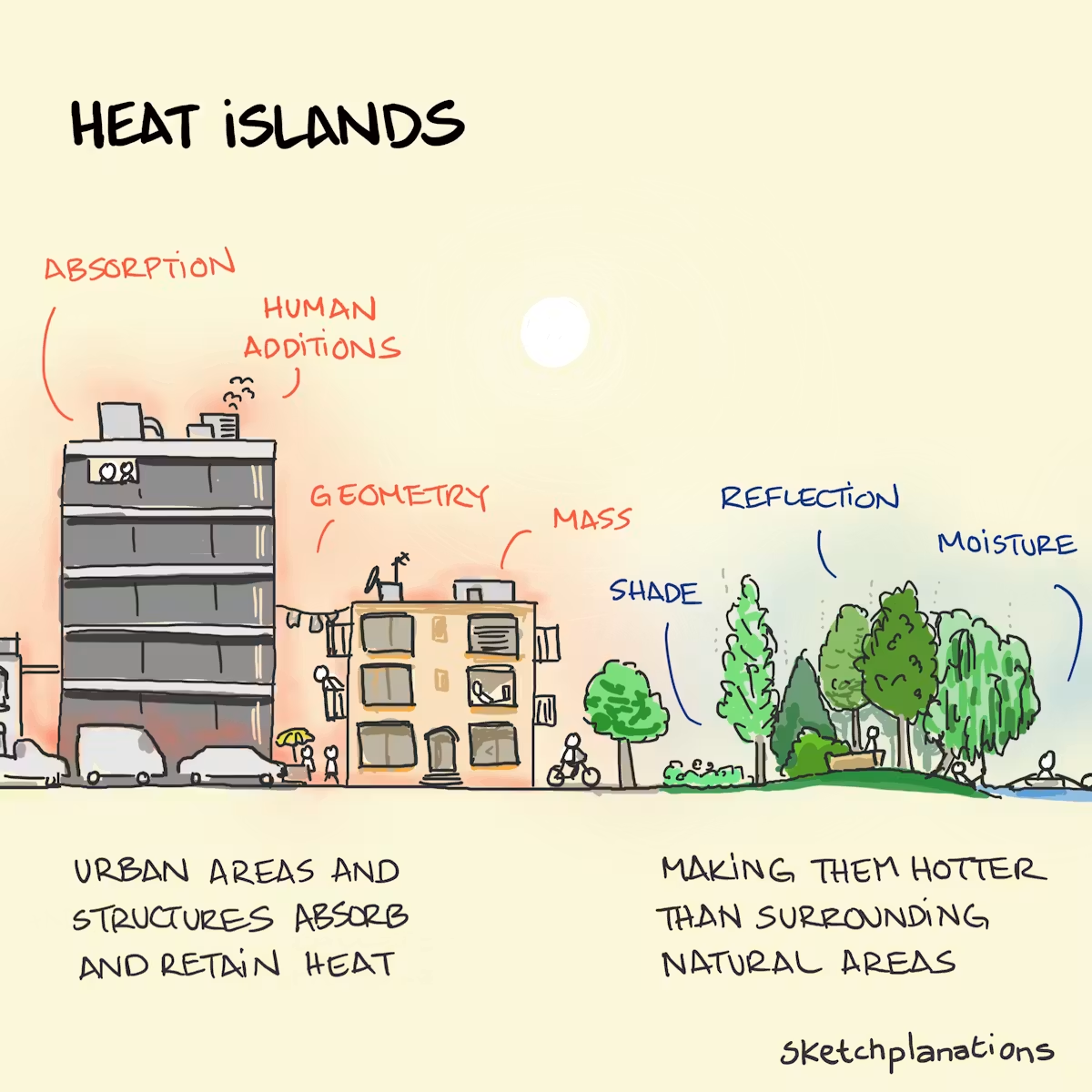
The project “Cooling the City: Assessing the Impact of Green and Blue Spaces on Urban Heat Islands for Evidence-Based Urban Policy and Planning in India” began in June 2025. It is funded by the Research Catalyst Grant of the University of Toronto India Foundation. The project is a collaboration between faculty members from NLSIU, Bengaluru, Brandeis University, USA, University of Toronto Mississauga, Canada, and the University of Rajasthan, Jaipur.
Rapid urbanisation, rising temperatures, and the loss or fragmentation of urban commons have intensified heat stress in Indian cities. Green and blue spaces—such as parks, tree cover, lakes, tanks, wetlands, and other open ecological spaces—can reduce heat exposure, but their cooling effects vary depending on their size, distribution, ecological quality, and surrounding built environment. Access to these spaces is also shaped by socio-economic inequalities, which influence how different communities experience and respond to urban heat. This project examines how green and blue spaces influence the Urban Heat Island (UHI) effect in Bengaluru and Jaipur, and how access to cooling benefits varies across neighbourhoods and socio-economic groups. The project seeks to generate evidence that can support climate-sensitive, socially equitable urban planning.
Project Description
The study combines geospatial analysis, remote sensing, socio-economic data, field observation, and neighbourhood-level interviews to understand the relationship between urban form, green-blue infrastructure, heat exposure, and social vulnerability. Bengaluru and Jaipur have been selected to compare heat dynamics across two different urban contexts: a large metropolitan city with rapid technological and spatial expansion, and a fast-growing tier-2 city located in a hot semi-arid region. The study will assess how urban form, vegetation, water bodies, impervious surfaces, and socio-economic characteristics interact to shape heat exposure and access to cooling. The project will also engage with urban planners, architects, municipal officials, researchers, and community stakeholders to translate research findings into policy-relevant recommendations for integrating green and blue spaces into urban design and planning.
Objectives
- The project has three primary objectives:
- To measure spatial variation in Urban Heat Island effects across selected neighbourhoods in Bengaluru and Jaipur;
- To map and analyse the availability, distribution, accessibility, and cooling effects of selected green and blue spaces.; and
- To examine the socio-economic correlates of heat exposure and access to cooling benefits from green and blue spaces.
Methodology
The project uses a mixed-methods research design. Remote sensing and geospatial analysis will be used to retrieve Land Surface Temperature (LST) and identify hot and cool spots across the selected study sites. The study will analyse environmental and spatial variables such as tree canopy cover, imperviousness, albedo, open space ratio, sky view factor, vegetation indices, water indices, building density, road density, and population density. The project will also assess the cooling performance of green and blue spaces through indicators such as cooling area, cooling intensity, cooling efficiency, cooling gradient, maximum cooling distance, and shape characteristics. In addition to spatial analysis, the project will examine socio-economic characteristics of selected neighbourhoods using census and other available data. Field visits, participant observations, and neighbourhood interviews will be conducted to understand how residents experience, mitigate, and adapt to heat stress, particularly in low-income and vulnerable communities. Q methodology will be used to identify key themes that different stakeholder groups prioritise.
Expected Outcomes
The project is expected to generate:
- Research publications on urban heat, green-blue infrastructure, and socio-spatial inequality which includes
- Remote sensing-based analysis of land surface temperature and urban heat patterns;
- Mapping of green and blue spaces across selected neighbourhoods;
- Assessment of cooling effects produced by parks, lakes, tree cover, and other green-blue spaces;
- Socio-economic analysis of access to cooling benefits; and.
- Field visits and neighbourhood interviews on lived experiences of heat stress.
- Policy briefs with ward-level and neighbourhood-level recommendations for heat-responsive urban planning;
- Geospatial outputs identifying priority areas for cooling interventions;
- Decision-making tools and frameworks to support the integration of green and blue spaces into urban planning; and
- Communication materials for planners, architects, municipal authorities, and other stakeholders.
- Workshops in Bengaluru and Jaipur will be conducted to share findings and build capacity for using geospatial evidence in urban design and governance. These workshops will include stakeholder including public officials, researchers, urban planners, and community representatives.
Potential Impact
The project aims to support more climate-resilient and equitable urban planning in Indian cities. By identifying how green and blue spaces reduce heat stress, and by showing who has access to these cooling benefits, the project will help inform planning decisions around land use, building norms, urban commons, ecological restoration, and public infrastructure. The findings will be relevant to municipal authorities, development authorities, urban planners, architects, researchers, and community organisations working on climate adaptation, urban sustainability, and environmental justice.
Duration
June 2025 -May 2026
Principal Investigators
NLSIU Lead
Dr. Sneha Thapliyal
National Law School of India University, Bengaluru
Dr. Prakash Kashwan
Brandeis University, USA
Dr. Praneeta Mudaliar
University of Toronto Mississauga, Canada
Dr. Chandra Morya
University of Rajasthan, Jaipur