

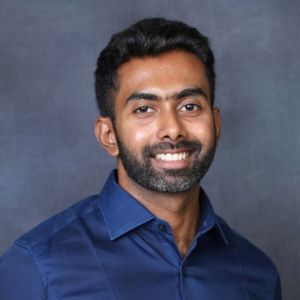
Dr. Sudheesh R C
Assistant Professor, Social Sciences
Co-Director, Academic Support Centre
Teaching
Academic Programmes
5-Year B.A., LL.B. (Hons.)
B.A. (Hons.)
Courses
Jul 2026
Mar 2025
Jul 2024
Mar 2024
Nov 2023
July 2023
Education
- DPhil in International Development, University of Oxford
- MSc. in Social Policy and Development, London School of Economics and Political Science (LSE)
- 5-Year integrated MA in Development Studies, Indian Institute of Technology (IIT) Madras
Profile
Sudheesh’s work spans the state, land, social policy, agrarian change and theories of development.
Sudheesh’s research explores the tension between demands for cultivable land and responses of the welfare state. Through an ethnographic study of land distribution measures taken up in response to Adivasi land struggles in Kerala, he has examined the specific citizen-state relationship that develops in such contexts. His research also tracks how long-term human intrusions into the environment have impacted the health of marginalised communities on the Western Ghats.
He is currently an Associate Editor of the Journal of South Asian Development. Prior to joining NLSIU, Sudheesh was an Assistant Professor at the School of Development, Azim Premji University, Bengaluru, where he taught courses on the state, land and qualitative research methods. Earlier, he worked as a research assistant with the Swiss Agency for Development and Cooperation in New Delhi, where he supported knowledge exchange on decentralisation among policymakers and practitioners in South and Southeast Asia.
Sudheesh received the Clarendon scholarship at Oxford, the Titmuss Prize for Outstanding Performance and a full scholarship at LSE, and the Dr Dilip Veeraraghavan Memorial Award for the Best Academic Record in development Studies at IIT Madras.
Research Interests
- The State
- Land
- Welfare and wellbeing
- Agrarian change
- The Idea of development
- Planetary health
- Political Ecology
Projects
- Co-Investigator, Planetary Health and Relational Wellbeing, funded by the British Academy, 2024-26.
The project combines archival and ethnographic methods and tries to understand what planetary health means for the lives of the most marginalised, resource-dependent communities and for the more-than-human actors they interact with on the Western Ghats. The investigation probes fundamental questions like what historical accountability for ecological destruction means, how ‘urgency’ gets framed in disaster management’ efforts, and why historically informed ethnography matters for climate research.
Publications
Journal articles
- Sudheesh, R.C. 2026. “Make Live and Let the Land Question Die: Surplus Population and the Welfare State.” The Journal of Peasant Studies
- Sudheesh, R.C. 2025. “Technical Diplomacy or Rendering Technical? Examining Triangular Cooperation in International Development.” Journal of International Development 37(6): 1295-1306.
- Sudheesh, R.C. 2025. “From Land Reform to Landfare: Land Claims and the Welfare State in Kerala, India.” Antipode: A Radical Journal of Geography 57 (2): 670-690.
- Sudheesh, R.C. 2023. “State Life: Land, Welfare and Management of the Landless in Kerala, India.” Development and Change 54(4): 870-891.
- Sudheesh, R.C. 2023. “Adivasi Migrant Labour and Agrarian Capitalism in Southern India.” Journal of Agrarian Change 23(4): 755-770.
- Sudheesh, R.C. 2016. “Social Protection as a Human Right in South Asia.” Indian Journal of Human Development 10(2): 236-252.
- Sudheesh, R.C. 2015. “State, Social Policy and Subaltern Citizens in Adivasi India.” Citizenship Studies 19(3/4): 436-449.
- Sudheesh, R.C. 2015. “Subaltern Struggles and Global Mediation in Koodankulam and Kashmir.” South Asia: Journal of South Asian Studies 38(2): 187-199.
- Sudheesh, R.C. 2013. “Decentralisation, Participation and Boundaries of Transformation: Forest Right Act, Wayanad, India.” Commonwealth Journal of Local Governance 12: 51-68.
Book Chapters
- Sudheesh, R.C. 2026. “Dominant Groups and Humiliation in Adivasi Kerala”. Development and the Tribal Question in India: Contours, Context and Contestations, edited by Roluah Puia and Viriginus Xaxa. New Delhi: Cambridge University
Media & Blogs
- Sudheesh, R.C. 2026. “Indian townships are rebuilding after landslides – but not everyone will benefit.” The Conversation. Jan 19. Republished in Scroll.in.
- Sudheesh, R.C. 2025. “How land restoration could address malnutrition among India’s Indigenous families.” The Conversation. 7 Oct. Republished in Scroll.in.
- Sudheesh, R.C and Dayal Paleri. 2025. Why no one is talking about counting caste in Kerala. The Indian Express, 13 June.
- Sudheesh, R.C. 2025. Narivetta’s Partial Image Of Muthanga Struggle: Adivasi Fight For Land Drags On For 22 Years. The News Minute, 10 June.
- Sudheesh, R.C. 2024. Mapping Landownership as Part of the Caste Census Could Uncover Key Patterns About Power, Resources. Scroll.in, 29 February.
- Sudheesh, R.C. 2023. Kaathal Kandirangunnavarude Kannerum Queer Raashtreeyavum (Malayalam: Tears of ‘Kaathal’ Viewers and Queer Politics). Trucopy Think. 5 December.
- Sudheesh, R.C. 2022. Aralam: Bhoomiyudeyum, Kshemathinteyum Raasthreeyam (Malayalam: Aralam: The Politics of Land and Welfare), The Malabar Journal, February.
- Sudheesh, R.C. 2018. Adivasi Keralavum Ghadanaparamaya Akramavum (Malayalam: Adivasi Kerala and Structural Violence). Keraleeyam, April-May.
- Sudheesh, R.C. 2018. 15 Years Since Muthanga, Promise of Land to Kerala’s Adivasis Remains Unfulfilled. The Wire. 19 Feb.
- Sudheesh, R.C. 2015. RCTs Inside and Outside India: Not Only a Methodological Debate. Agenda for International Development.
- Sudheesh, R.C. 2015. Why the SDGs are Not That Sustainable. Agenda for International Development.
- Sudheesh, R.C. 2015. Marginalisation and the Media: How does the Subaltern Respond to Mediation. LSE South Asia Blog. London: London School of Economics and Political Science.
- Sudheesh, R.C. 2014. What Rights for the Queer Aadmi in India? LSE South Asia Blog. London: London School of Economics and Political Science.
Book Reviews
- Sudheesh, R.C. 2026. Review of Neoliberalism and Hindutva in the Making of an Indian Smart City (New Delhi: Cambridge University Press). The Journal of Peasant Studies.
- Sudheesh, R.C. 2025. Struggles for Labour and the Environment: Frictions and Intersections (Review of Raman, K. Ravi. 2025. Political Ecospatiality. New Delhi: Cambridge University Press and Satheesh, Silpa. 2025. Labour, Nature and Capitalism. London: UCL Press). Development and Change 56(6): 1287-1299.
- Sudheesh, R.C. 2023. “Top Dressing or Deep Roots?” Review of Cultivating Democracy: Politics and Citizenship in Agrarian India by Mukulika Banerjee, Economic and Political Weekly 58(11): 30-32.
- Sudheesh, R.C. 2018. Unpacking How Indigeneity Originates as a Political Narrative. Review of Indigenist Mobilization: Confronting Electoral Communism and Precarious Livelihoods in Post-Reform Kerala by Luisa Steur, Dialectical Anthropology 42 (1): 97-99.
Reports
- Sudheesh, R.C. 2019. Persistence of Poverty in an Indigenous Community in Southern India: Bringing Agrarian Environment to the Centre of Poverty Analysis. Occasional Paper 1. Geneva: United Nations Research Institute for Social Development.
- Sudheesh, R.C. 2017. Social Justice and Queerness. Agenda for International Development.
- Rozina Hajiani, Sophie Sidhu, Sudheesh R.C. and Won Ki Hong. 2011. Kishori Chitrapata: Empowering Adolescent Girls Through ICT. New Delhi: Unicef.