
Book Talks@NLS Library | ‘Seeking Allah’s Hierarchy: Caste, Labor and Islam in India’ | by Dr. P. C. Saidalavi
Conference Hall (Ground Floor), Training Centre, NLSIU
Registration is mandatory for the public. To register, click here.
Wednesday, May 13, 2026, 5:15 pm
Open to the public
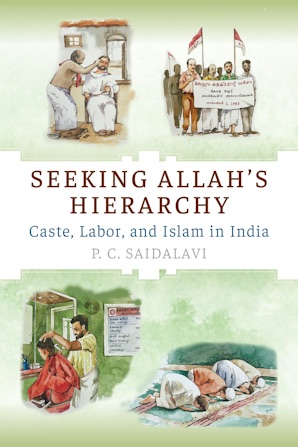
The Library Committee is organising a Book Talk on the book ‘Seeking Allah’s Hierarchy: Caste, Labor, and Islam in India,’ authored by Dr. P. C. Saidalavi and published by the University of Pennsylvania Press in 2025.
The talk will take place on Wednesday, May 13, 2026, from 5:15 PM at the Conference Hall (Ground Floor), Training Centre, NLSIU and is open to the public subject to prior registration.
Panellists:
- Dr. P C Saidalavi, Assistant Professor, Sociology, Shiv Nadar University
- Dr. Karthikeyan Damodaran, Assistant Professor, Social Sciences, NLSIU
- Dr. Shireen Azam, Postdoctoral Fellow, NLSIU (Moderator)
About the book
In Seeking Allah’s Hierarchy, P. C. Saidalavi provides an ethnographic study of a Muslim barber community in South India, unraveling how these barbers negotiated concepts of hierarchy through Islamic values of piety, genealogy, morality, and wealth. Through this close-drawn study, Saidalavi argues that Muslim hierarchy exists and it works on its own terms. It both draws upon Islamic jurisprudential and moral discourses and is shaped by the larger economic, cultural, and political environment, including that of Hinduism. Yet ultimately, Muslim hierarchy is neither a replica nor a watered-down version of caste in Hinduism.
Seeking Allah’s Hierarchy contends that the Islamization process in South Asia cannot be reduced to conceptual schemas or patterns dictating religious practice. Instead, this process works within a “lived tradition,” in which Muslims attempt to infuse and rationalize their practices using their interpretations of Islamic values, meanings, and purpose. In this case, barbers challenged other Muslims’ perception of them as hierarchically inferior by emphasizing their religious piety. Yet those same Muslims also drew on Islam to provide a rationale for categorizing barbers’ work as morally obligatory but undignified, thus rendering the barbers “lower.”
The barbers’ challenge to this perceptual hierarchical order was inspired by communist political activities in Kerala and commenced when they started unionizing in the 1970s. By establishing shops, instituting uniform pricing, and standardizing working hours, barbers successfully transformed their work relations into labor within the strictures of capitalist market relations. Recounting their story here, Saidalavi complicates the question of “caste” found in the Indian subcontinent by showcasing the specificity of hierarchical practices among Muslims, despite the egalitarianism of their religion.
About the Panellists
Dr. P C Saidalavi is a cultural anthropologist with a background in sociology, literary and cultural studies. He works as an assistant professor at the department of Sociology in the School of Humanities and Social Sciences, Shiv Nadar University, Delhi-NCR. His PhD thesis in Anthropology, which looked at the social hierarchy among Muslims in Malabar, South India, was awarded the Raymond Firth Thesis Prize in Anthropology from the Australian National University in 2022 His broad research interests lie in anthropology of religion, climate change, youth cultures and South Asia (India and Sri Lanka).
Dr. Karthikeyan Damodaran is an Assistant Professor, Social Science at the National Law School of India University, Bengaluru. He was previously a Research Fellow, affiliated to the Centre for Modern Indian Studies, University of Goettingen, Germany. He has also worked as Assistant Professor at the Department of Asian Studies, School of Creative Liberal Education, Jain (Deemed to be) University. He was a recipient of Principal’s Scholarship for his PhD at the University of Edinburgh. His previous research focused on caste processions and commemorations in Tamil Nadu, and his current research looks at performances of traditional masculinity in contemporary times.
About the moderator:
Dr. Shireen Azam is a Postdoctoral Fellow at the National Law School of India University, Bengaluru. She is a political theorist working at the intersection of caste, religion, and labour. At NLSIU, Shireen will work on her first monograph, tentatively titled ‘Reclaiming Caste: A New History of the Muslim in Modern India.’ Her recently concluded DPhil at the University of Oxford centres around lower-caste Muslims in the political and constitutional history of India from late 19th-21st century. While housed at the Faculty of Theology and Religion, she taught undergraduate courses in History, Anthropology, and Politics at Oxford.