

Conference on ‘Addressing the Contract Labour System and Contractualisation of Workforce’ | By Centre for Labour Studies, NLSIU
Conference Hall, Training Centre, NLSIU
Open to the public Register here.
Saturday, April 11, 2026, 10:00 am
The Centre for Labour Studies (CLS) at NLSIU is organising a day-long conference on “Addressing the Contract Labour System and Contractualisation of Workforce” as per the details below:
- Day & date: Saturday, April 11, 2026
- Time: 10:00 AM to 5:30 PM
- Venue: Conference Hall, Training Centre, NLSIU
Open to the public Register here.
The conference will bring together leading scholars, trade union representatives, lawyers, and workers to examine the rapid expansion of contract labour in India and its implications for job quality, labour rights, and social equity.
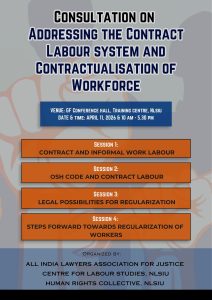 Session Details
Session 1: The Political Economy and Working of Contract Labour in India (10:30 to 12:30 PM)
Across the world, standard forms of employment – characterised by secure tenure, formal contracts, and access to social security – are steadily declining. In their place, non-standard forms of employment such as contractual work and gig-based work are expanding rapidly. In the Global South, including India, such forms of employment have long been widespread. However, the growing reliance on contract labour – one of the most prominent forms of non-standard employment – raises important questions about job quality and workers’ rights.
Governments and employers frequently justify the use of contract labour as essential for flexibility, productivity, and employment generation, often claiming that rigid labour laws limit firms’ ability to grow. Yet research suggests that contract employment is also used to weaken the bargaining power of permanent workers and reduce labour costs. The Economic Survey 2015–16 observed that states with more rigid labour laws actually witnessed faster growth in contract labour, challenging the claim that labour flexibility alone explains this expansion.
Evidence shows deep inequalities between regular and contract workers. A study by V.V. Giri found that contract workers in private establishments earned only 68% of the wages of regular workers, while in public employment they earned just 45%, highlighting substantial wage gaps. Contract workers also face limited access to creches, canteens, and social security, while hiring practices reflect sharp caste and gender biases, with women disproportionately employed in low-paying contractual roles such as housekeeping and sweeping.
Despite these challenges, workers and unions have resisted through strikes, protests, and legal interventions, sometimes achieving regularisation. Yet the overall trend remains concerning: the 2022-23 Enterprise Survey reports that 43% of Central Public Sector employees are contract workers, up from 19% in 2015, while the Annual Survey of Industries (2021-22) shows 40% of industrial workers are contract-based.
This panel will bring together workers, union leaders, and economists to explore the realities of contract labour in India. It will examine structural inequalities and forms of resistance, providing a critical overview that sets the stage for subsequent discussions on conditions of work, labour jurisprudence, and pathways for strengthening workers’ rights and protections.
Speakers:
- Rajesh Jospeh, Azim Premji University
- Ramadevi, Bruhat Bengaluru Mahanagara Palike Pourakarmika Union
- Vijayakumar, HAL Contract Workers’ Association
- Karuna Dietrich Wielenga, Azim Premji University
- Maitreyi Krishnan, AICCTU (Moderator)
Session 2: Occupational Safety, Health, and Working Conditions Code (OSH Code) and Contract Labour (12:45PM to 1:45PM)
In 2025, the Union Government notified four labour codes, consolidating and replacing a wide range of labour laws that had governed workers’ rights for over a century. Among the laws subsumed was the Contract Labour (Regulation and Abolition) Act, 1970, which, despite its limitations, had provided an important framework for regulating contract labour. Under the new Occupational Safety, Health and Working Conditions (OSH) Code, many of these protections have been significantly weakened.
The OSH Code raises the threshold for its applicability, narrows the scope of regulation, and allows the use of contract labour even in core and permanent activities. It specifically keeps out certain works from the definition of core and permanent work, and these include works performed by historically marginalized sections of society.
The OSH Code also reduces certain employer liabilities toward workers. Collectively, these changes raise serious concerns about the future of decent work, job security, and workplace protections for contract workers.
This panel will examine in detail the implications of the newly enacted OSH Code for workers, highlight its differences from the previous legal framework, and discuss its potential impact on judicial interpretations and the broader jurisprudence of labour law.
Speakers:
- Meenakshi Sundaram, CITU
- Maitreyi Krishnan, AICCTU
- Saurabh Bhattacharjee, Center for Labour Studies, NLSIU (Moderator)
Session 3: Contract Labour and the Courts: The Evolving Jurisprudence of Regularisation (2:30PM to 3: 45 PM)
For over a quarter of a century, an important part of labour’s struggle against contractualisation has unfolded in the courts, particularly before the Supreme Court and various High Courts across India. In disputes concerning both public and private employment, the judiciary has often been the final forum where workers seek recognition of their claims for regularisation.
Two landmark judgments frequently cited as restricting the rights of contract workers are Steel Authority of India Ltd. v. National Union Waterfront Workers (2001) and Secretary, State of Karnataka v. Uma Devi (2006). In the first case, the Supreme Court held that contract workers do not have an automatic right to absorption into permanent employment. In the second, the Court ruled that the regularisation of ad hoc or temporary employees could amount to granting “backdoor entry” into government service, thereby significantly narrowing the scope for regularisation.
In the years since these decisions, however, courts – including the Supreme Court – have revisited and interpreted aspects of these rulings in more nuanced ways. Judgments such as Jaggo v. Union of India, Shirpal & Another v. Nagar Nigam Ghaziabad, and the recent decision in Dharam Singh v. State of Uttar Pradesh have softened some of the rigid implications of earlier rulings. These decisions have carved out limited exceptions and created some space for recognising the rights of daily-wage and contractual workers.
At the same time, the legal terrain continues to evolve. A case currently pending before the Supreme Court, Oil and Natural Gas Corporation v. Krishnan Gopal, raises the important question of whether labour and industrial courts have the authority to order regularisation when there are no sanctioned posts.
This panel seeks to unpack the complex and contested jurisprudence surrounding contract labour through a discussion of key court decisions. Bringing together labour lawyers and trade union leaders, it will examine how courts currently approach demands for regularisation and what these developments mean for workers’ struggles today.
Speakers:
- Sudha Bharadwaj, Trade Unionist and Labour Lawyer, High Court of Bombay
- Muralidhara, Labour Lawyer, High Court of Karnataka
- Saurabh Bhattacharjee, Center for Labour Studies, NLSIU
- Avani Chokshi, AICCTU (Moderator)
Session 4: Contract Labour after the Labour Codes: Regulation and Path Forward (4PM to 5:30PM)
Despite the notification of the four labour codes by the Union Government, considerable ambiguity persists regarding their implementation. Many State Governments are currently in the process of formulating and notifying rules to operationalise these codes, while also considering alternative measures including passing state-specific legislation to address potential adverse impacts. This includes introducing additional legal protections for workers who may be excluded from the scope of the new framework.
Such state-level interventions are not unprecedented; under the earlier labour regime, states such as Tamil Nadu and Assam enacted laws providing for the regularization of workers after a defined period of service – protections that are not uniformly available to workers in other states across the country.
In this context, the panel aims to bring together representatives from the judiciary, trade unions, workers, and academia to reflect on the implications of the new legal framework governing contract labour and to discuss possible responses to the challenges it presents including considering the proposal to submit a bill on the regularization of employment to the Government of Karnataka. The panel will also briefly examine and deliberate on provisions in the model law on regularisation drafted for submission to the Karnataka Government.
Speakers:
- VJK Nair, CITU
- Clifton D’ Rozario, AICCTU
- Babu Mathew, AITUC (Moderator)