
Faculty Development Workshop Series | Call for Applications for Teaching Negotiation and Mediation in India | By NLSIU, UC Law SF & CAMP Mediation
NLSIU Campus | Register here
Saturday, July 11, 2026
This two-day workshop will be held on July 11 & 12 | Apply by May 27
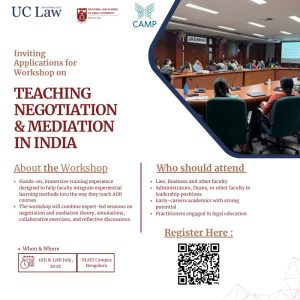
The National Law School of India University (NLSIU), Bengaluru in collaboration with the University of California College of Law, San Francisco (UC Law SF) and CAMP Mediation, Bengaluru, invites applications for a Faculty Development Workshop on ‘Teaching Negotiation and Mediation.’ The two-day workshop will be held on July 11 & 12, 2026.
This invitation-only cohort workshop is designed for law teachers interested in shaping the future of alternative dispute resolution (ADR), mediation, and negotiation education in India.
Why this workshop?
India stands at an inflection point in dispute resolution. With increasing court backlogs and dissatisfaction with arbitration, mediation is emerging as a central pillar of civil justice reform. The demand for lawyers trained in effective mediation advocacy and counseling skills has become more important than ever. Yet across most law schools in India, training in these subjects remains theoretical, lecture-based, and disconnected from practice.
By contrast, leading law schools in the United States and elsewhere have for decades delivered ADR and negotiation courses in an “experiential” format using role-play simulations adapted from actual practice. These courses are popular with students and are widely regarded as the gold standard in skills-based legal education. The American Bar Association now requires all law students to complete at substantial number of experiential courses prior to graduation.
Over the past two years, faculty from UC Law SF, working closely with CAMP and NLSIU, have piloted and refined a model for bringing this pedagogy into Indian classrooms. They have developed teaching materials, including syllabi, role-plays adapted to the Indian context, and a video of a mediation conducted by Senior Advocate Sriram Panchu – all designed to introduce skills-based learning in lecture classes of 60 or more students. These efforts have received positive feedback from both students and faculty.
About the Workshop
This is not a conventional academic programme. It is a hands-on, immersive training experience designed to help faculty integrate experiential learning methods into the way they teach ADR courses. Participants will:
- Experience role plays as a student
- Receive coaching in how to structure, facilitate, and debrief role plays as a teacher
- Learn how to design, facilitate, and debrief simulations
- Learn how to adapt U.S. style experiential teaching methods to the Indian context
- Receive access to curated teaching materials and other resources developed by UC Law SF and CAMP Mediation
- Work directly with leading educators and practitioners from the U.S. and India
The workshop will combine expert-led sessions on negotiation and mediation theory, simulations, collaborative exercises, and reflective discussions. The two-day in-person workshop will be preceded by 2–3 shorter, virtual sessions.
Participants who successfully complete the programme will receive a Certificate of Completion from NLSIU.
Who should Apply?
We seek a small, carefully selected cohort of participants currently teaching (or interested in teaching) ADR, mediation, or negotiation, including:
- Law, Business, or other faculty
- Administrators, Deans, or other faculty in leadership positions or responsible for curriculum design at their home institutions
- Early-career academics with strong potential
- Practitioners engaged in legal education
Resource Persons
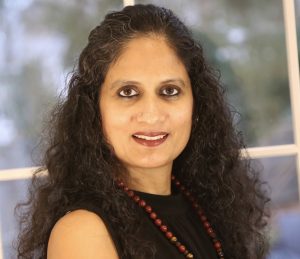
Tara Ollapally is an international lawyer and mediator with over 25 years of experience across the United States and India. She is the co-founder of CAMP Arbitration and Mediation Practice Pvt. Ltd., one of India’s pioneering private mediation institutions, and has been actively involved in advancing the mediation movement in India since 2015.
Tara regularly trains lawyers, mediators, and professionals in negotiation and mediation. She is part of the CAMP–Edwards Mediation Academy faculty, has taught at multiple law schools in India, and has served as Coordinator for the Mediating Disputes course at Harvard University.
Her mediation practice spans family, inheritance, commercial, construction, real estate, education, and consumer disputes. Her facilitative approach supports parties in reaching informed, collaborative outcomes grounded in mutual understanding.
Tara is licensed to practice law in New York and Bangalore, India, and holds an LL.M. from Columbia Law School.
You can learn more about Tara at www.taraollapally.com

Corey Linehan is Associate Director of the Center for Negotiation & Dispute Resolution at the University of California College of the Law, San Francisco. He holds faculty appointments at Bay Path University and Georgetown University Law Center, where his teaching focuses on negotiation, communication, and legal practice. As a consultant with Triad Consulting, he works with organizations and leaders to more effectively address conflict.
Outside his teaching and training, Corey’s career has focused on negotiating complex public policy and government matters. He previously served in roles at the U.S. Department of Justice and U.S. Senate navigating interbranch conflicts and advancing legislation from drafting through enactment.
Corey holds a JD from Harvard Law School, MEd from the University of Missouri—St. Louis, and BSFS from Georgetown University. He is barred in California.
Read more: https://www.uclawsf.edu/people/corey-linehan
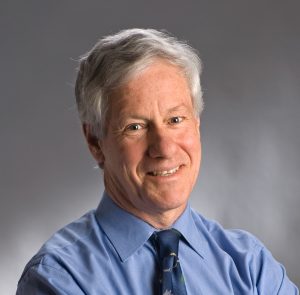
Dwight Golann has been a mediator and teacher of dispute resolution for more than thirty years. A Research Professor of Law at the University of California Law—San Francisco and Suffolk University—Boston and, he has led trainings for U.S. government agencies, the European Union, and ADR organizations on five continents.
Professor Golann has resolved hundreds of legal disputes and is the author of the American Bar Association’s leading books on mediation, Mediating Legal Disputes and Sharing a Mediator’s Powers. He formerly served as Chief of the Trial Division for the Massachusetts Attorney General, litigating cases at every level of the American court system.
He is the only person to have received the Lifetime Achievement Award of the American College of Civil Mediators and the ABA Award for Outstanding Scholarship in Dispute Resolution.
Read more at: https://www.suffolk.edu/academics/faculty/d/g/dgolann
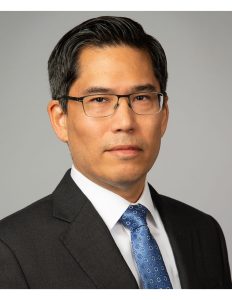
Hiro N. Aragaki is a tenured professor of law at University of California College of Law, San Francisco and the Faculty Director of its Center for Negotiation and Dispute Resolution. He is also a Professorial Research Associate at SOAS College of Law in London. His scholarship in ADR has won prestigious accolades and been published in top U.S. law journals, including flagship law reviews at NYU, the University of Pennsylvania, and UCLA. He has consulted on ADR reform projects around the world, including as an Advisor to the Supreme Court of India’s Expert Committee on Mediation (tasked with drafting the bill that would become the Mediation Act, 2023) and as a mediation expert for the World Bank’s Business Ready Project.
He has served as a mediator and arbitrator for over twenty years, most recently with JAMS, is a Chartered Arbitrator and Fellow of the Chartered Institute (U.K.), and a Fellow of the College of Commercial Arbitrators (U.S.).
Read more at: https://www.uclawsf.edu/people/hiro-aragaki
Selection Process
Participation is competitive and by application only. Interested candidates may apply through the form Teaching Negotiation and Mediation. Applicants will be selected based on academic and professional background and demonstrated interest in ADR, including mediation.
Required Documents:
- Curriculum Vitae
- Statement of Purpose outlining motivation and expected outcomes from the workshop (in not more than 500 words)
Application Deadline
Last date to apply extended to May 27, 2026. Decisions will be made on a rolling basis until all seats are filled.
Fee & Logistics
- Workshop Fee: INR 15,000
- Participants are responsible for travel and accommodation, the details of which will be shared with shortlisted participants
Session Agenda
Teaching ADR with experiential pedagogies
This two-day faculty development workshop will focus on the experiential pedagogies most suited to courses in alternative dispute resolution, especially those focused on negotiation and/or mediation. The two-day in-person workshop will be preceded by two virtual sessions, both up to two hours in length, that will ensure all participants arrive for the workshop with a rich understanding of the dispute resolution theory to which the pedagogies explored at the workshop are aligned. The in-person sessions will provide participants an opportunity not just to study new teaching tools but to practice implementing them in an interactive, experiential context.
Day 1: Morning Sessions
The workshop will open with an exploration of the purposes of experiential education and how the pedagogies to be explored over the weekend relate to a model ADR curriculum to which participants will have access. Participants will study and practice active listening frameworks that strong negotiators, mediators, and advocates in ADR processes use. The session will then also teach tools for providing students feedback in an experiential context, including distinctions between coaching and evaluative assessment.
Day 1: Afternoon Sessions
The afternoon sessions will focus on best practices for using roleplays to teach negotiation—including their purposes, how to set them up, and how to debrief them so that students’ experiences are translated into robust theoretical and practical takeaways. Participants will have the opportunity to practice debriefing a negotiation roleplay and use the listening and feedback frameworks presented in the morning session.
Day 2: Morning Sessions
The second day will open with an opportunity to recap and interrogate anew key themes from the first day’s sessions. The focus will then shift to deploying experiential techniques to teach mediation. Participants will lean and practice an exercise to help students distinguish mediation from arbitration as common alternative resolution pathways. They will then also have an opportunity to practice using demonstration videos to tech key structural elements of the mediation process.
Day 2: Afternoon Sessions
The final afternoon will begin with an opportunity for participants to learn and practice several exercises from a model ADR curriculum, including exercises on active listening and mediator selection. There will then be an opportunity to explore roleplay and debrief differences for mediation cases. The day will conclude with an opportunity to identify and articulate key takeaways from the weekend.
Contact Us
For any queries, please write to .
Related Link: The workshop is being organised as part of NLSIU’s Faculty Development Workshop Series. The first workshop was on ‘Teaching Criminal Law: Curriculum, Syllabus & Pedagogy,’ was held in November 2025.