
Faculty Seminar | Remembering and Forgetting the Last Nawab’s Bharuch
Conference Hall, Ground Floor, Training Centre
Open only to NLS Faculty
Wednesday, March 4, 2026, 3:30 pm
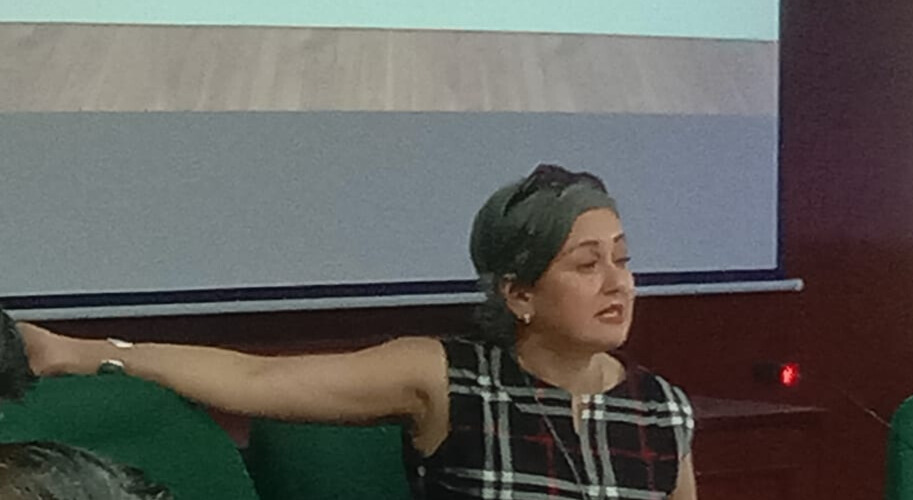
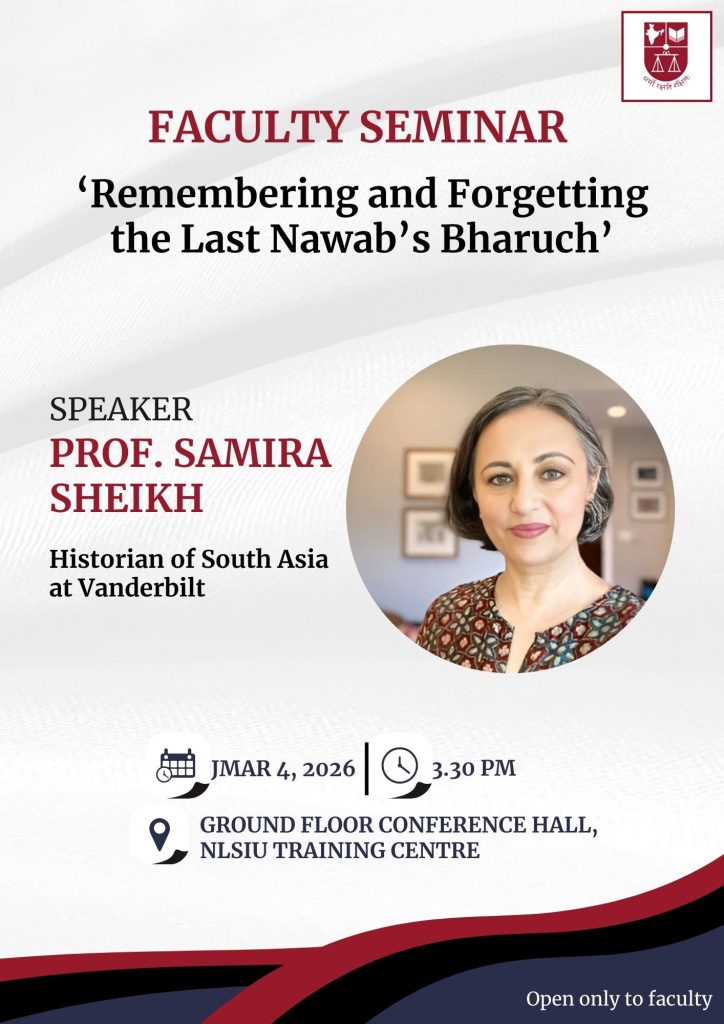 We began our faculty seminar series this trimester with a guest lecture by Prof. Samira Sheikh, historian of South Asia at Vanderbilt, and the Obaid Siddiqi Chair in the History and Culture of Science, 2025-26 at the NCBS in Bengaluru. The seminar was held on March 4, 2026, at 3.30 pm, in the Ground Floor Conference Hall at NLSIU’s Training Centre.
Prof. Sheikh presented the sixth chapter of her book manuscript on the city of Bharuch in western India in the eighteenth century, which examines how, as the East India Company’s power expanded and the Mughal Empire grew ever more remote, the people of Bharuch adapted to new realities. The book brings to life the travails of individuals caught in a rapidly transforming world, while showing how the traces of those who experienced early colonialism have been obscured by subsequent political developments.
Abstract
Remembering and Forgetting the Last Nawab’s Bharuch
In the decades after the British conquest of Bharuch, Persian and Urdu chroniclers composed elegiac accounts of Nawab Mu‘azzaz Khan’s defeat, some blaming Lallubhai Dayaldas, his Hindu Vaishnava land-revenue accountant’s “loose talk” for its fall. On the other side, British documentation offered a cooler, more dismissive portrait of the nawab and denied collusion with Lallubhai. By the twentieth century, nationalist intellectuals such as K. M. Munshi — himself descended from a scribe who had served both Mu‘azzaz and Lallubhai — recast the eighteenth century in moralized terms. For Munshi, the period’s pragmatic alliance politics and fiscal opportunism were inconvenient reminders of a decentralised, plural past. For Munshi and other nationalists, loyalty was rewritten as allegiance to the nation and betrayal became a national sin rather than a breach of patronage.
The stakes of the book lie in this shift. Colonial and nationalist epistemologies have narrowed the field of vision through which eighteenth-century India can be seen. Small polities such as Bharuch, which thrived through multilingualism and alliance, did not fit comfortably within imperial teleologies or nationalist narratives. The Muslim nawab who fled into exile did not resemble the heroic figures later nationalism preferred. The revenue capitalist who speculated and collaborated became an emblem of moral failure. Over time, Mu‘azzaz’s Bharuch faded from view; Lallubhai’s reputation as a self-serving traitor endured.
Chapter 6 also follows the material afterlives of the sources themselves. On the one hand, manuscripts preserved in a Persianate Muslim family archive entered the National Archives of India as dispersed “Oriental Records,” catalogued by genre rather than by provenance. On the other, a Persian letter collection preserved by K.M. Munshi’s family was edited and printed under the auspices of a nationalist institution. The differential visibility of these archives reflects shifts in language regimes, communal politics, and state formation. Archives, in my account, do not merely preserve the past; they structure what later historians can recover and, indeed, the official record itself.
About the Speaker
Samira Sheikh is a historian of South Asia and an Associate Professor of History at Vanderbilt University, where she specialises in the political and religious history of the Indian subcontinent from c. 1200–1950. Her research interests encompass politics and religion in South Asia, early modern trade networks, pre-colonial and early Indian cartography, and the social and economic history of regions such as Gujarat. She has also received fellowships, including support from the American Council of Learned Societies, for projects exploring early modern Gujarati maps and other historical themes. She is the author of Forging a Region: Sultans, Traders and Pilgrims in Gujarat, 1200-1500 (Oxford India, 2010), and co-editor of After Timur Left (Oxford India, 2014), and An Anthology of Ismaili Literature: A Shi’i Vision of Islam (I.B. Tauris and the Institute of Ismaili Studies, 2008).