
Panel Discussion on ‘Valuing the Invisible: Recognising Women’s Unpaid Domestic Work’
Ground Floor Conference Hall, Training Centre, NLSIU
Register here
Tuesday, December 30, 2025, 5:00 pm
Open to the public.
The National Law School of India University, Bengaluru, organised a panel discussion on “Valuing the Invisible: Recognising Women’s Unpaid Domestic Work” on December 30, 2025 in the Ground Floor Conference Hall at Training Centre. The panel discussion was organised under a Humboldt University Research Grant.
Overview
This discussion critically examined the status of women’s unpaid domestic and care work in India. It aimed to move beyond welfare and dependency-based narratives to foreground unpaid domestic work as socially indispensable. The discussion explored pathways for recognising, valuing, and compensating unpaid domestic work as an essential part of the production and reproduction of society.
Panellists
Jayna Kothari, Senior Advocate, Supreme Court of India & Co-founder, CLPR
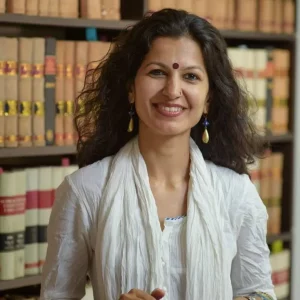 Jayna Kothari has been practicing as an Advocate in the Karnataka High Court in Bangalore and the Supreme Court since the last 16 years. Her areas of expertise and interest include public interest law, constitutional and administrative law, social rights, disability rights, family law, consumer rights and property law. She is the founder of the Centre for Law and Policy Research, Bangalore since 2009.
Some of the landmark cases in which she has appeared include the constitutional challenge in the Supreme Court of India to the Right of Children to Free and Compulsory Primary Education Act 2009, a litigation in the High Court of Karnataka on addressing out of school children and finding remedies to bring them back to school, the case of National Federation for the Blind v. State of Karnataka in which more than 300 categories of government jobs were identified and reserved for persons with disabilities in the State of Karnataka, and a public interest litigation challenging the controversial Upper Bhadra irrigation Project in Karnataka undertaken without forest and wild life clearances.
Besides taking elective courses at NLSIU, she has taught an Advanced Course on the Human Right to Education at the Norwegian Centre for Human Rights, University of Oslo (2015); an Advanced Course on Justiciability of Economic, Social and Cultural Rights at Abo Akademi University, Finland (2014); and a course on Human Rights Law at University Law College, Bangalore (2003).
Prof. Kamala Sankaran, Professor of Law & Ford Foundation Chair in Public Interest Law, NLSIU
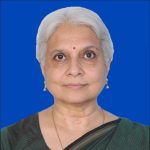 Prof. Sankaran comes with a rich teaching experience from across various premier institutions in the country. She has previously served as the Vice-Chancellor of the Tamil Nadu National Law University, Tiruchirappalli, as Professor at the Campus Law Centre, Faculty of Law, University of Delhi, and as Research Professor, Indian Law Institute, New Delhi. She is a recipient of the Fulbright Post-Doctoral Research Fellowship at the Georgetown University Law Center, Washington D.C. She has also been a Visiting South Asian Research Fellow, School of Interdisciplinary Area Studies, Oxford University, and a Fellow at the Stellenbosch Institute of Advanced Study, South Africa. Her research interests include constitutional law, international labour standards, and the regulation of work. She has also been a member of the Committee of Experts on the Application of Conventions and Recommendations (CEACR), ILO, since 2018.
Prof. Kanchana Mahadevan, Former Professor & Head, Department of Philosophy, University of Mumbai
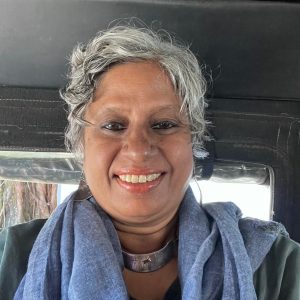 Kanchana Mahadevan is Visiting Faculty at the Masters in Public Policy Programme St. Xavier’s College. She was formerly a Professor at the Department of Philosophy, University of Mumbai (from September 1995 to October 2024). She has held visiting professorships at LUISS University, Rome (2016, 2019) and Leopold Franzens University, Innsbruck (2023). She has also been a senior fellow at the Justicia Amplificata, Goethe University Frankfurt and Bad Homburg (2018) and the Moore Institute, National University of Ireland, Galway (2019).
She received her PhD in Philosophy (on Jürgen Habermas’s communicative ethics) in 1993 at the University of Georgia, USA. She works in the fields of political philosophy, ethics, feminist philosophy, continental thought and critical theory. She also works in the interdisciplinary areas of aesthetics and film.
Her authored book Between Femininity and Feminism: Colonial and Postcolonial Perspectives on Care (Indian Council of Philosophical Research in collaboration with DK Printworld New Delhi, 2014) examines the relevance of Western feminist philosophy in the Indian context. She has co-edited two books on Gandhi, namely, Gandhi Then and Now: Autobiographies and Conversations and Inheriting Gandhi: Influences and Activisms (both published by Speaking Tiger, New Delhi, 2022). She has also coedited a volume of philosophical and psychological essays on the pandemic entitled The COVID Spectrum: Theoretical and Experiential Perspectives (Speaking Tiger Publications, New Delhi 2021).
Her research paper publications on Ambedkar explore his re-articulation of democracy from the Indian perspective. In her recently published research on care ethics, she has explored its critical potential in relation to health care work (nursing practices in particular) and the cosmopolitan character of care.
Moderator
Dr. Sharada R Shindhe, Assistant Professor of Law, NLSIU
 Dr. Sharada R Shindhe is an Assistant Professor of Law at National Law School of India University, Bengaluru. She is a recipient of the prestigious Dr. D. C. Pavate Memorial Fellowship at the Centre of International Studies, University of Cambridge. Her research has been published in various journals, and she has delivered special lectures across multiple areas of law.
Currently, she teaches Family Laws and Arbitration at NLS. Her Ph.D. is in arbitration. Her ongoing research interests include Social Reproduction Theory, with a particular emphasis on women’s free time and unpaid domestic work.
Registration
The session is open to the NLS community as well as to the public. Those interested in attending the event are requested to fill out the registration form before 5 pm on Saturday, December 27, 2025.