

Play Reading | Poile Sengupta’s ‘Thus Spake Shoorpanakha, So Said Shakuni’ | By The Green Room
NAB 101
Wednesday, November 12, 2025, 5:00 pm
Open only to the NLS community.
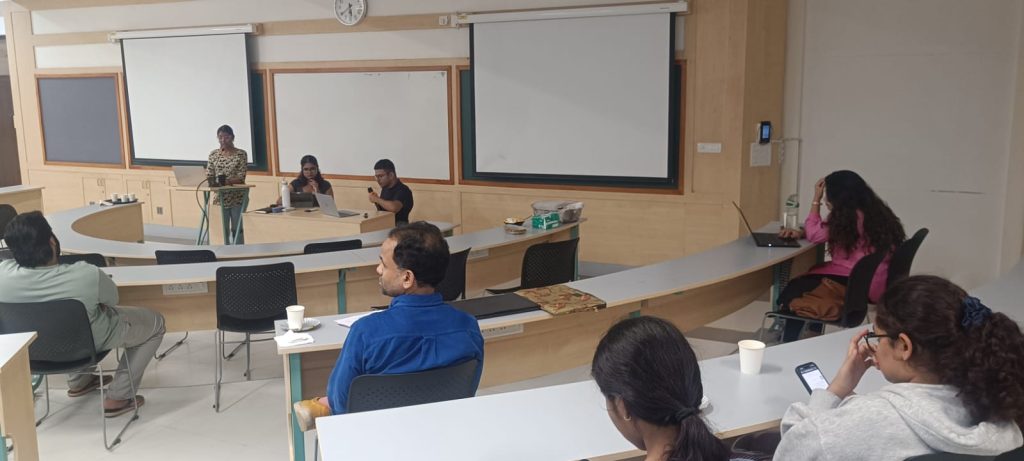 The student-led theatre effort at NLS, The Green Room, organised a reading of Poile Sengupta’s ‘Thus Spake Shoorpanakha, So Said Shakuni‘ on November 12, 2025.
The Green Room is a nod to the intimate, lively backstage space in theatres where artists gather before a performance. Here is the exciting schedule for this trimester.
Playwright and the Play
Poile Sengupta is one of India’s most significant contemporary playwrights and writers, known for her sharp reimaginings of familiar narratives through the lenses of gender, power, and socio-political critique. Last trimester, she visited NLS for a reading of her play Alipha, organised by the Literary and Debating Society.
Her play ‘Thus Spake Shoorpanakha,’ So Said Shakuni similarly brings two of Indian epics’ most misunderstood “antagonists” — Shoorpanakha (Ramayana) and Shakuni (Mahabharata) — into a contemporary, conversational world. Through humour, confrontation, and self-awareness, the play asks a radical question: were they truly villains, or simply characters rewritten by victors? Bold, witty, introspective, and political, it is a perfect piece to read, perform, and debate.
About the Session
This sharp, ironic work reimagines two mythological figures—Shoorpanakha from the Ramayana and Shakuni from the Mahabharata—through a contemporary feminist and political lens.
The session opened with a table reading led by our volunteers, Sanya (III year, BA LL.B.) and Tathagat (I year, BA), followed by an engaging discussion on the play’s exploration of alternative histories, narrative construction, desire, revenge, and the architecture of power. Participants reflected on the importance of asking who builds dominant narratives, against whom such narratives operate, and who becomes instrumentalised within them.
The gathering also examined how the characters’ decisions are propelled by distinct emotional worlds, such as love, anger, wounded pride, and how these intensities shape the choices they make.