

Seminar on ‘Mapping Labour, Power, and Regulation in India’s Platform Economy’ | By Centre for Labour Studies, NLSIU and Rosa Luxemburg Stiftung
OAB 101
Saturday, December 20, 2025
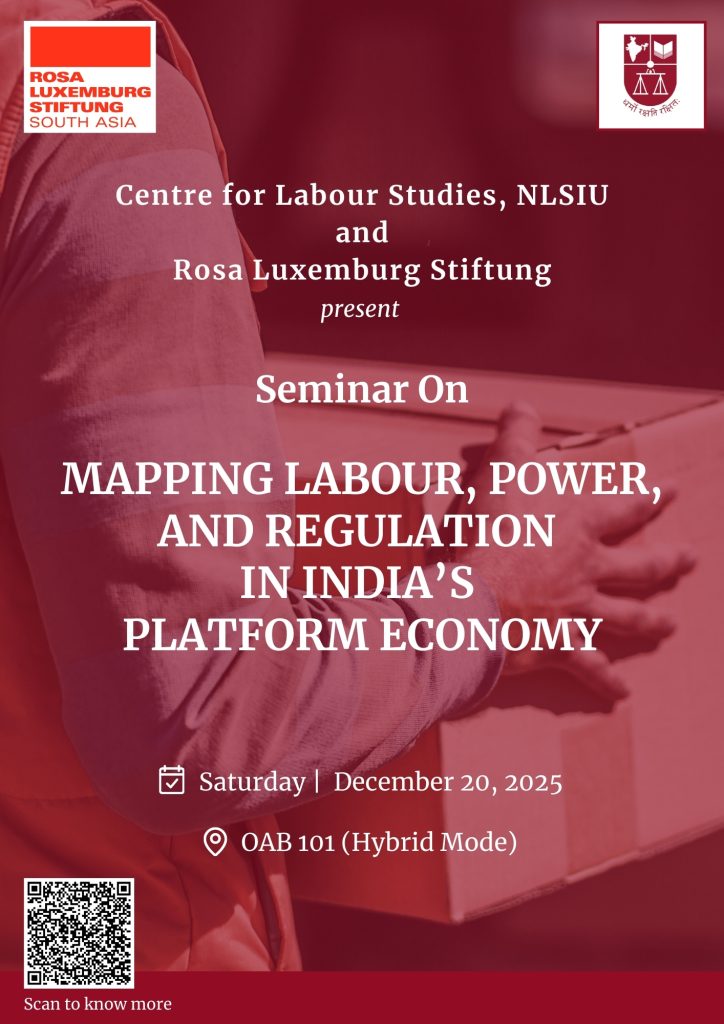 The Centre for Labour Studies (CLS) at the National Law School of India University, with the support of the Rosa Luxemburg Stiftung, is organising a seminar on ‘Mapping Labour, Power, and Regulation in India’s Platform Economy’ on Saturday, December 20, 2025.
About CLS
The Centre for Labour Studies (CLS) at NLSIU is an interdisciplinary centre focussed on examining the regulation and governance of labour and employment relations. Over the past three years, CLS has been deeply engaged in issues concerning gig and platform workers, publishing more than a dozen reports on various aspects of platform-mediated work. These studies explore the working conditions of food delivery and ride-sharing workers in Bengaluru and Hyderabad, as well as the impact of algorithmic management and digital platform monopolies on labour practices. CLS has also closely followed and advised on the Karnataka Platform-Based Gig Workers (Social Security and Welfare) Act, 2025, providing critical inputs on the legislation and its rules.
About The Seminar
As part of its broader engagement with gig and platform labour, CLS supported by the Rosa Luxemburg Stiftung (RLS) is hosting a day-long seminar on December 20, 2025, to be held in hybrid mode – both on campus and online. With the ILO preparing to draft a global convention on platform work in 2026, multiple Indian states introducing diverse platform-worker legislations, and the central labour codes now notified, the need for sustained dialogue on the rapidly evolving gig and platform economy has become increasingly urgent.
Overview
The seminar will feature panel discussions on emerging forms of platformisation, the growing monopolisation of the platform economy, and the expanding role of algorithmic management in shaping work conditions. It will also review the range of state-level legislations enacted across India and work toward developing a collective roadmap for an expanded regulatory framework for platform work.
A key outcome of the event will be to work towards a framework for a strengthened and comprehensive platform-work regulatory model, one that can serve as a blueprint for worker unions seeking to reinforce existing laws or advocate for new protections in their respective states.
How To Join Online?
Meeting ID: 325 253 898 014 16
Passcode: Ez6WX6b2
Schedule
India’s platform economy is evolving rapidly, moving well beyond the familiar domains of ride-hailing and food delivery. A wider range of household services—domestic and care work, beauty services, home repairs, plumbing, carpentry, and various skilled trades—is now being reorganised through digital platforms. These sectors involve more complex, varied tasks and distinct labour arrangements, making their dynamics fundamentally different from delivery or transport work. The sector’s growing significance is underscored by Urban Company’s recent profit before tax of ₹28.6 crore in FY25, along with the rise of platforms such as NoBroker, YesMadam, and numerous region-specific service providers.
Despite these trends, India still lacks a detailed understanding of how the household-services in the platform sector functions. This session is conceived as an exploratory panel aimed at mapping the urban services sector – both in terms of understanding its political economy including mapping major actors, how traditional forms of work have reconfigured and looking at working conditions of workers including how platforms shape job allocation, ratings, earnings, and control, and how these dynamics differ from delivery and ride-hailing platforms.
The platform model is built around two fundamental tenets – market dominance and geographical ubiquity. Market dominance is essential to choke out potential competition and geographical equity to shorten response times. These factors have specific impacts on the various stakeholders, including principally, the platform workers and the consumers of platform services. With respect to workers the challenge becomes how to attract ever increasing numbers of platform ‘partners’ and retain their services even while the platform itself becomes progressively less attractive as an employment option with crowding of that space. With consumers, the challenge becomes ensuring loyalty, while expanding the consumer base. In essence, the logic becomes simple – streamline costs even while selling the workers the illusion of large potential earnings; maintain service standards for consumers to keep them hooked on to the platform; lower consumer prices to the extent of keeping competition at bay. In essence, invest in improved services while charging low to consumers – buy dear and serve cheap. This upside-down market logic makes sense only when we understand creating market dominance is an end in itself for the platform. It allows the platform to expand horizontally into related business areas, gathering more consumers and gaining access to their market data in the process. Data itself becomes a profitable commodity.
This session will examine why and how understanding the logic and political economy of digital platforms is crucial for workers and unions and explore how regulation—including antitrust interventions—can be used to create fairer markets.
As algorithms increasingly coordinate and supervise labour across workplaces, it has become crucial to understand how these systems function and how they affect working conditions. Although often associated with the digital platform economy, evidence indicates that algorithmic management is rapidly permeating diverse forms of work, including public sector employment, marking a new phase of labour control and discipline.
However, in India, the regulation of algorithmic management remains largely absent from the agendas of labour unions and the government. At the same time, industry actors argue that algorithms are proprietary technologies, placing them outside the purview of labour regulation and public oversight. As a result, algorithmic management sits at a critical juncture—deeply relevant to contemporary labour governance yet largely overlooked in policy and regulatory discussions.
Against this backdrop, this session will examine how algorithmic management is understood globally and within India, present recent research findings from CLS and IT for Change on working conditions shaped by algorithmic control and open the floor for a discussion on possible regulatory pathways for governing algorithms in the Indian context.
The past year has witnessed a rapid proliferation of platform-related legislations at the state level in India. While broadly similar in structure—and notably uniform in their failure to recognise gig and platform workers as “workmen”—these state laws nevertheless exhibit important variations in their details and scope. Adding to this evolving legal landscape is India’s recent decision to notify the long-pending labour codes, which include limited provisions for the social security of gig and platform workers. At the same time, many state legislations represent only an initial step toward regulating platform labour, falling short of fully addressing the complexities of platform work and, more broadly, algorithmically mediated work.
This session seeks to take stock of India’s current regulatory framework on platform labour by analysing the various state-level legislations, examining potential synergies and conflicts between these laws and the newly notified labour codes, and discussing what an expanded and forward-looking regulatory framework for platform work should entail.