

Dr. Sony Pellissery Participates At The Second World Summit for Social Development | Nov 2025
December 2, 2025
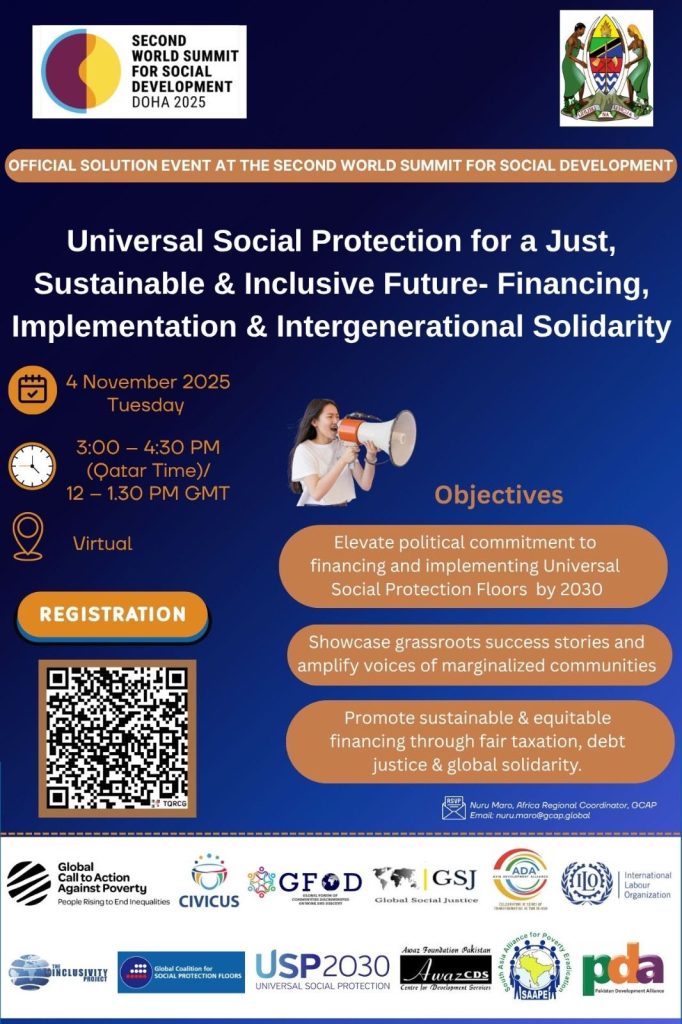 Dr. Sony Pellissery, Professor and Co-Director, Centre for the Study of Social Inclusion (CSSI) at the National Law School of India University (NLSIU), Bengaluru, spoke at a virtual solution session at the Second World Summit for Social Development, held between November 4-6, 2025. The session was titled ‘Universal Social Protection for a Just, Sustainable and Inclusive Future- Financing, Implementation, and Intergenerational Solidarity.’
Session on Universal Social Protection
Prof. Sony spoke on why finance alone does not address the challenge of universalising social protection in South Asia. He spoke on four sectors where universalisation of social protection has been a challenge — construction workers, gig workers, domestic workers and scheme workers with the government. Both in the segments of construction workers (builders paying a premium as social security contribution for workers in order to gain approval of building plans) and gig workers (those who receive service paying a fraction of service fee through apps) finance has not been a challenge. But, in the segment of domestic workers, collection of contributions from employers has been a challenge. A positive element in that segment is mobilisation of women to resist violences they have been subjected to, and bargaining capacity for wages when they are organised. The case of scheme workers with the government faces another set of challenges, particularly with minimum wage. The positive aspect in this segment has been access to several benefits like insurance for healthcare. These comparative cases show how sectors are widely divergent when the question of universalisation in the informal sector is addressed.
For the panel, Prof Sony was joined by:
Moderator: Paul Ladd, former Head of UNRISD (United Nations Research Institute for Social Development) and currently Director of Sustainable Development for the UNECE Region
Speakers
- Isabel Ortiz, Director, Global Social Justice – “Advancing Global Social Justice: Solutions to Tackle Inequality and Finance Universal, Inclusive Social Protection” Background and Rationale
- UN Deputy Secretary-General or other high-level UN representative – Global leadership and multilateral commitments
Lok Bahadur Thapa, Ambassador of Nepal to the UN – “Regional Leadership and Multilateral Support for Social Protection in LDCs” - Government Representative from Tanzania – “National Pathways to Achieving Universal Social Protection: Policy, Practice, and Political Commitment”
- Christina Behrendt, Head, Social Policy Unit, ILO Universal Social Protection Department – “The role of the ILO in advancing the implementation and monitoring of social protection systems, including floors”
- Gray Panthers – “Social Protection Across Generations: Dignity for Older Persons and Intergenerational Solidarity”
- Beena Pallical, Co-Chair, Global Forum on Communities Discriminated by Work and Descent (GFoD) – “Innovative and Ethical Financing: Towards a Global Fund for the Most Marginalised”
About the Summit
The first World Summit for Social Development was held in Copenhagen in 1995, following which 177 nation-states adopted a political resolution to fight poverty.
30 years later, the second social development summit was held in Doha. More than 40 Heads of State and Government, over 230 ministers and senior officials, and nearly 14,000 attendees took part in the summit.
Takeaway
The 3-day summit ended with the adoption of the Doha Declaration.
The Doha Political Declaration of the Second World Summit for Social Development (2025) reaffirms global commitments to the Copenhagen Declaration, the 2030 Agenda, human rights, and inclusive multilateralism, acknowledging that progress on poverty eradication, decent work, and social inclusion has been too slow and uneven. Leaders highlighted persistent and emerging challenges – including rising poverty and inequality, informal and precarious work, gender gaps, youth unemployment, weak social protection, digital divides, climate change, conflicts, demographic shifts, and strained global financing. The Declaration commits countries to accelerate poverty eradication through social protection floors, quality education, decent work policies, support for small enterprises, gender equality, and targeted investments in health, food security, resilient infrastructure, and sustainable agriculture. It emphasised universal health coverage, digital inclusion, safe use of emerging technologies like AI, strengthened labour rights, and inclusive policies for children, women, older persons, migrants, Indigenous Peoples, and persons with disabilities. The text stresses the need for major reforms to the international financial architecture, expanded development financing, fairer tax cooperation, and stronger support for developing countries. It concludes with a pledge to strengthen follow-up mechanisms, enhance multilateral cooperation, and conduct a five-year review from 2031 to assess progress and renew commitments toward achieving social development for all.
Click here to know more.