

Workshop on ‘Balancing Public Health and Personal Autonomy: Vaccine Governance, Proportionality, and Regulatory Design in India’ | JSW Centre for the Future of Law
Online | Open to the public
Tuesday, May 26, 2026, 5:00 pm
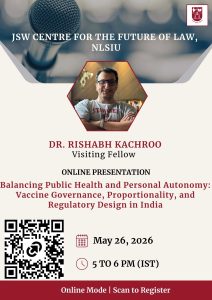
The JSW Centre for the Future of Law at NLSIU is organising a workshop on the topic, ‘Balancing Public Health and Personal Autonomy: Vaccine Governance, Proportionality, and Regulatory Design in India’ with Dr. Rishabh Kachroo.
- Day & date: Tuesday, May 26, 2026
- Time: 5:00 – 6:00 PM
- Mode: Online
The talk is open to the public. Kindly register here for the Webinar link.
Abstract
This paper examines India’s COVID-19 vaccination governance as a constitutional and regulatory design problem; doing so by focussing on the uneasy relationship between public health necessity, bodily autonomy, executive power, and legal justification. It argues that the pandemic revealed a deeper grammar of governance in which rights-burdening policies could be operationalised through guidelines, standard operating procedures (SOPs), administrative circulars, and access-based conditionalities without assuming the form of formal mandates. Exploring the gap between formal voluntariness and practical compulsion, this paper argues that vaccination was often carried out de-facto mandatorily. This execution involved material consequences for the citizenry.
The paper then proceeds further to claim that India’s pandemic response was shaped by an unstable statutory architecture that enabled a dispersed ecology of executive instruments. The resulting governance structure made it difficult for citizens to locate, contest, or demand justification for restrictions that affected their rights.
Another layer of analysis that this paper offers concerns scientific uncertainty. Vaccine-related restrictions were justified through evolving claims about transmission, severity, and risk reduction. The paper argues that in such cases, the State bears an obligation to make scientific premises legible, contestable, and updateable, while the courts must demand a reviewable evidentiary record and prevent uncertainty from becoming a vehicle for unexamined deference. Thus, this paper links proportionality, administrative legality, vaccine safety governance, transparency, and public trust in a bid to push the normative claim that emergency public health law must be designed to act under uncertainty without normalising constitutional shortcuts.