
Three-Day National Seminar on ‘Ideas of Self Determination in Adivasi World’ | By NLSIU and St. Mary’s College, Sulthan Bathery
St. Mary’s College, Sulthan Bathery, Wayanad
Wednesday, February 11, 2026
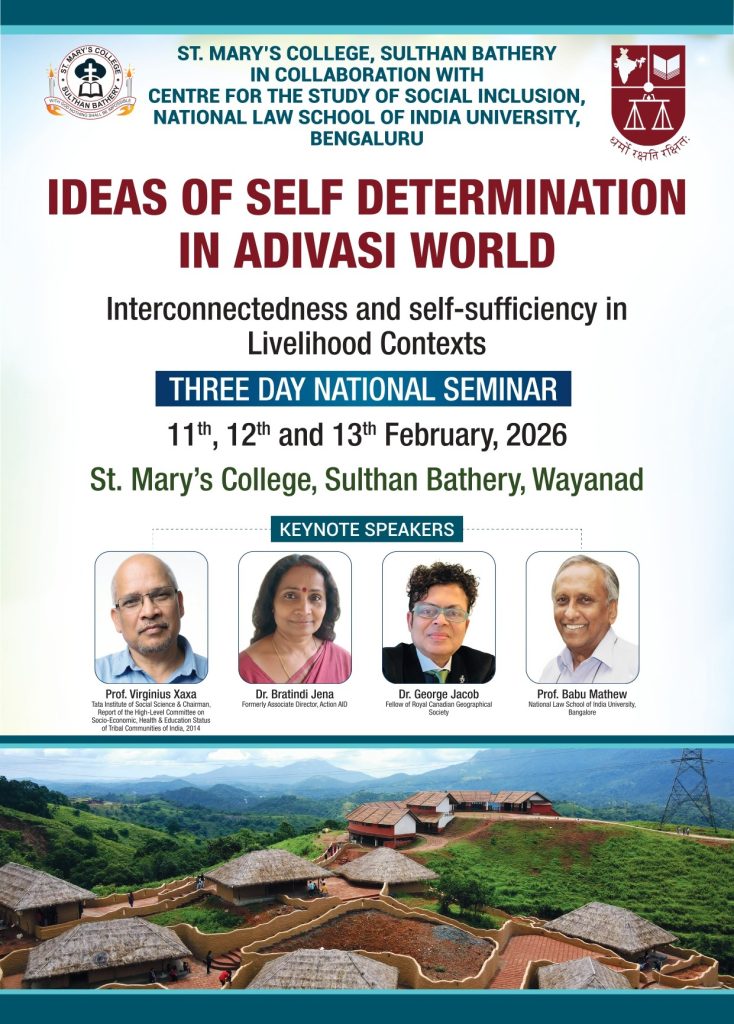 The National Law School of India University (NLSIU), Bengaluru, in collaboration St. Mary’s College, Sulthan Bathery, Wayanad, is organising a three-day national seminar on ‘Ideas of Self Determination in Adivasi World’ between February 11 and 13, 2026.
About the Seminar
Research, literature and discourses have presented Adivasi communities as passive victims to contemporary changes in the market society. Very few post-colonial literature has focused on the resistance by Adivasi groups on the development models imposed on them. Apart from constitutionally mandated reservation provisions for jobs and political representation, predicaments of Adivasi communities are determined by several contemporary changes in society and market. Often research has focused on traditional institutions and governance system. Question on welfare research has been limited to how adivasi communities access government programmes. However, an inquiry into market and technological changes would be able to show how the ideas of self-determination has changed through emerging aspirations.
This seminar would like to take note and document positive elements of resilience and adaptation towards technology and market from Adivasi communities across country. These changes are marked by the nature of interaction between settlers and Adivasi communities. Some of these changes are monetization of natural resources (primarily land but also other natural resources of jal-jungle), penetration of English medium schools, modern health care facilities, tourism, availability of fast-moving consumer goods, exposure to media that shapes the demands internally, new modes of entertainments through alcohol and drug, and changes to transcendental institutions such as religion. How are Adivasi communities responding to these contemporary changes? How is technological adoption, and changes to traditional livelihoods taking place in the context of market penetration? This is the key question that a three day national seminar to be held at St. Mary’s College, Sultan Bathery will be addressing
Schedule
The seminar will include panel discussions on the following themes:
- Legal Services in Adivasi Areas
- Transformative Practices on Livelihood Promotion
- Mobility Aspirations of Adivasi Youth
Apart from paper presentations from across the country, there will also be visits and cultural programmes to familiarise with Adivasi communities in the Western Ghats.
View The Full ScheduleAbout St. Mary’s College, Sulthan Bathery
The first higher education aided institution in Wayanad, St. Mary’s College, Sulthan Bathery was established in 1965. Founded by Rev. Fr. Mathai Nooranal to throw light of education to the back ward district of Wayanad, it has 11 undergraduate and 9 post-graduate programmes. The College also has four Research Centres. SMC is also a study-centre for two open universities namely IGNOU and Sree Narayana Guru Open University. The research facilities include DST-FIST Instrumentation Facility, dedicated research scholar’s hub and state-of-the-art Library. The college renders invaluable service to the holistic transformation of Wayanad and its people. The college was reaccredited with” A+” grade by NAAC in 2023.
About National Law School of India University (NLSIU), Bengaluru
NLSIU was the first National Law University established in India in 1986. The premier law school was set up with a mis sion to pioneer legal education reforms, and to anchor the transformation of the Indian legal system through research and policy interventions. Consequently, NLSIU was one of the first institutions in the country to introduce the five-year integrated law degree at the undergraduate level from 1988 onwards. Since then, the University has irrefutably remained a leader in the field of legal education in the country. This long-standing record has been possible due to the strong collaborations between legal academics, the Bar, the Bench and the State Government of Karnataka.