
Book Talk on Rohit De and Ornit Shani’s ‘Assembling India’s Constitution: A New Democratic History’ | By M. K. Nambyar Chair
Basement, NLSIU Library
Monday, December 15, 2025, 5:30 pm
Open only to the NLS community.
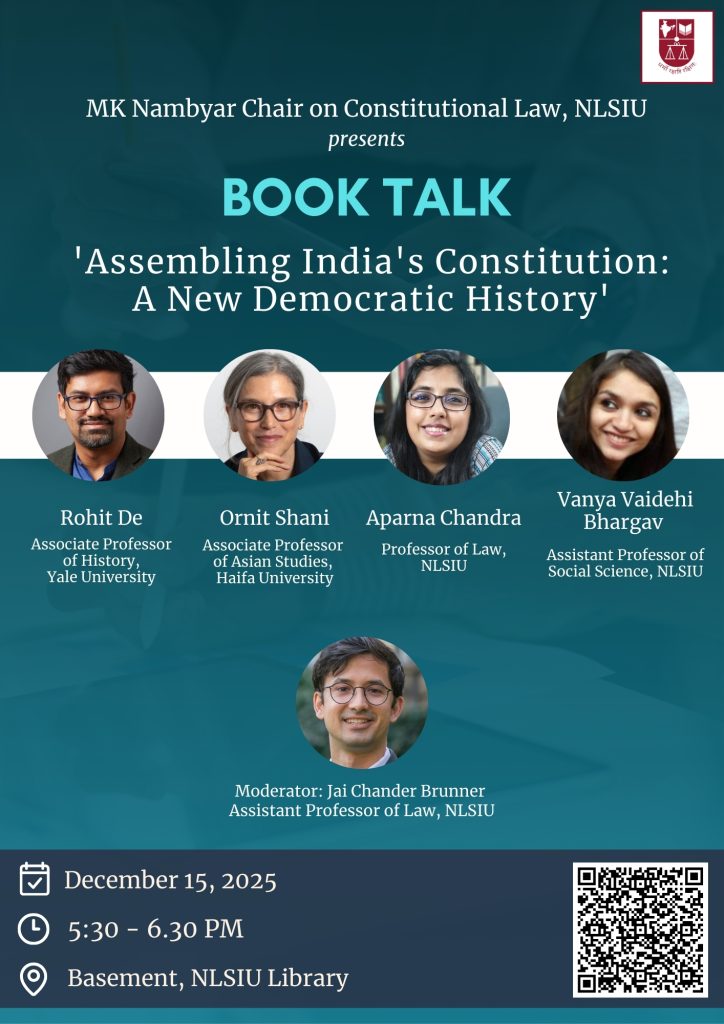 The M. K. Nambyar Chair on Constitutional Law is hosting Rohit De and Ornit Shani to speak on their recently released book, Assembling India’s Constitution: A New Democratic History. The talk will take place at the Basement, NLSIU Library, between 5:30 and 6:30 PM on Monday, December 15, 2025.
The event will begin with a panel discussion, followed by an audience Q&A.
About the Book
De and Shani’s book challenges canonical understandings of the making of India’s Constitution. Most scholarship has foregrounded the work of the Constituent Assembly, assuming that “constitutional politics and details were beyond the imagination, interest and capacity of the Indian people, and that this process did not occupy their concerns” (7). By contrast, De and Shani argue that the Constitution was fit together through “disparate and simultaneous constitution-making efforts across the country,” stemming from “large and diverse publics” (13-14). In other words, the people contributed to the assembling of India’s Constitution.
Authors
- Rohit De is a legal historian at Yale’s Department of History. He was awarded the J. Willard Hurst Prize for his last book, A People’s Constitution: The Everyday Life of Law in the Indian Republic.
- Ornit Shani teaches Modern Indian History at the Department of South Asian Studies, University of Haifa. Her previous book, How India Became Democratic: Citizenship and the Making of the Universal Franchise won the 2019 Kamaladevi Chattopadhyay New India Foundation Prize
Panellists
- Aparna Chandra heads the M. K. Nambyar Chair on Constitutional Law at the National Law School. She primarily teaches constitutional law and comparative public law. Her last book, Court on Trial: A Data Driven Account of the Supreme Court of India, builds on a decade of original empirical research to interrogate the functioning of the Indian Supreme Court.
- Vanya Vaidehi Bhargav is an intellectual historian of Modern South Asia at the National Law School. In her first book, Being Hindu, Being Indian: Lala Lajpat Rai’s Ideas of Nationhood, she challenges the idea that Lajpat Rai can be reduced to an ideological ancestor of modern Hindutva.
Moderator
Jai Brunner teaches constitutional law and jurisprudence at the National Law School. His current research interests lie in using legal theory to identify problems of indeterminacy in Indian Supreme Court reasoning.