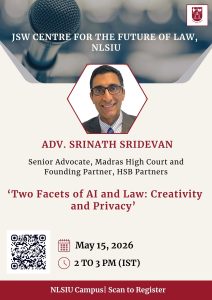
The seminar is open to NLS Faculty, researchers and students upon prior registration. If you are interested in attending, register here.
About the Seminar
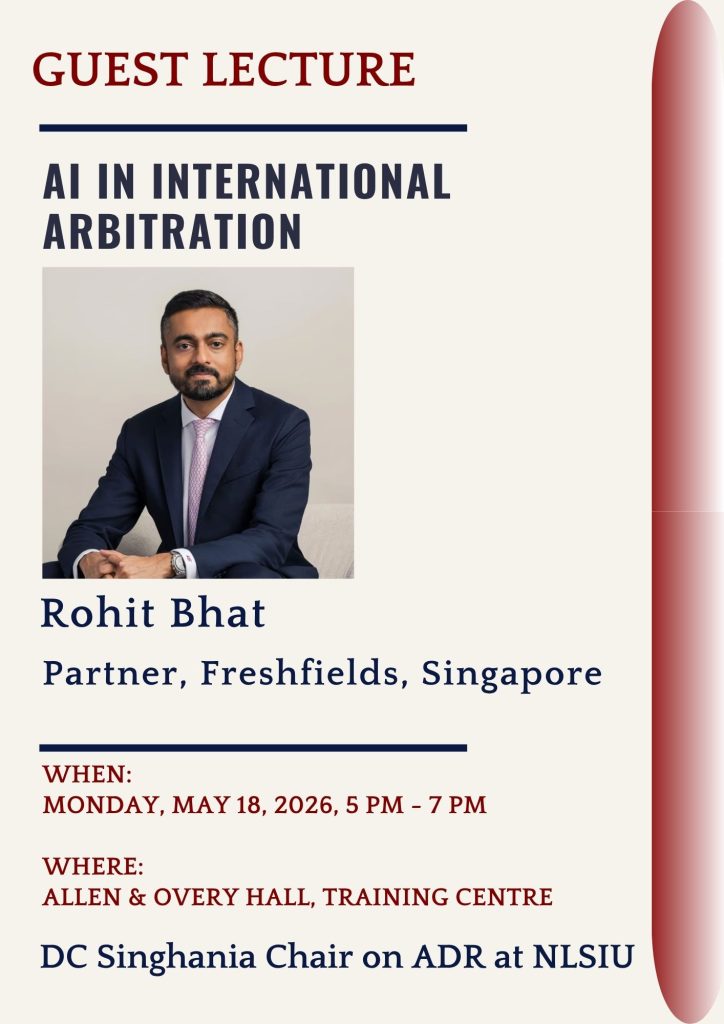
If there is one aspect that has touched probably all our lives in the last several years, it is definitely, Artificial Intelligence. Having functions like learning, reasoning, problem solving, data analysis it has impacted our lives and work in more ways than one. Siri, Alexa, Google Assistant, Search Engines, Social Media, E-commerce, Healthcare, transportation have all been effected. Whether it is designed for specific tasks or frees human beings for more creative work is debatable.
Some have called it terrifying, others helpful. Microsoft plans to invest USD 17.5 billion in India alone for AI development over the next four years from 2026 to 2029, to drive infusion of AI into the population at large. The Seminar aims to discuss the various views on AI, how it is changing the world, how it impacts the legal profession – whether it is for bad or it is for good and if so, how bad or good.
Seminar Schedule
To know about the seminar schedule please click here.
The National Law School of India University (NLSIU), Bengaluru and Singapore International Arbitration Centre (SIAC) are organising the third edition of the Annual Arbitration Lecture on Saturday, April 25, 2026, from 10 am to 12 noon at the Aurora Auditorium (Falcon’s Den), Prestige Falcon Towers, Brunton Road, Ashok Nagar, Bengaluru.
This event is open to the public. Please note if you are outside of the NLS community, it is mandatory to register for the event. Kindly RSVP on the form.
This year, we have Mr. V K Rajah SC, International Arbitrator, Duxton Hill Chambers (Singapore Group Practice) speaking on: “Ethical Theatre: Soft Law, Hard Truths The Present Challenge of Arbitration Ethics.”
Abstract
International arbitration has built a gilded library of ethical codes. Without enforcement, it is pageantry—ornate in form, hollow in force. Proliferation is not control. What binds is law, not exhortation.
The fiction that arbitration is purely private, insulated from public scrutiny, has run its course. Its authority is borrowed from the public legal order: state recognition, judicial supervision and mandatory norms no agreement can displace. Confidentiality should not be a licence for impunity. If impropriety is not policed with credibility, legitimacy will decay, then the process will be policed from outside, or bypassed altogether. State-driven reforms of investor–state arbitration were the first warning shot. India’s retreat from arbitration in high-value public contracts was the next. The signal is global.
Three structural defects endure: no democratic anchor, no uniform enforceability, no centralised discipline. Soft law soothes institutions, but institutions compete and hard enforcement risks market share. Competition invites accommodation, not accountability.
Reform requires four commitments: consequences that bite, transparency in challenge decisions, structural checks on repeat conflicts, and institutional courage. Ethical lapses must have consequences. Otherwise, it is theatre.
About the Speaker
Mr V K Rajah SC is International Arbitrator, Duxton Hill Chambers (Singapore Group Practice).
With his extensive experience Mr Rajah SC has served as both Chair and Panel Arbitrator in a wide range of high-profile international cases. He is highly sought after for commercial arbitrations across Asia.
His career spans significant contributions to the legal sector, including public service as a Judge of Appeal and Attorney-General of Singapore. He has played an influential role in shaping the country’s legal landscape.
Among the many committees he led, the 2007 Committee to Develop the Singapore Legal Sector was perhaps the most significant. It proposed transformative reforms that have since significantly shaped the legal landscape. Key recommendations included liberalising legal services to allow select foreign firms to practice Singapore law, enhancing market diversity and competitiveness; strengthening legal education through the establishment of the Singapore Institute of Legal Education and mandatory Continuing Professional Development; and taking steps to establish Singapore as a leading global dispute resolution hub.
He has been Chairman of the National Advisory Council on the Ethical Use of AI and Data since 2018. In 2024 the Medical Faculty of the National University of Singapore established a professorship on medical ethics in his name.
Please note:
All press/media invitees who are interested to cover the talk are requested to please carry their ID cards.
The Queer Archive for Memory, Reflection, and Activism (QAMRA) and the Centre for Intellectual Property Research and Advocacy (CIPRA) jointly organised a roundtable titled ‘Copyright in Practice: Perspectives from Archives and Libraries.’
Event Details
Venue: Ground Floor Conference Hall, Training Centre, NLSIU
Day & Date: Saturday, March 28, 2026
Timings: 9.30 AM – 1.30 PM
Open to the public.
About the Roundtable
This roundtable examined how copyright law shapes – and sometimes constrains – the work of archives and libraries. Copyright is one of the most important, and very often poorly understood, aspect of archiving and librarianship.
Professionals in the fields of archives, libraries, and intellectual property and copyright law came together to address concerns and conceptualise best practices. The roundtable primarily had two sessions: the first consisted of archivists and librarians sharing their insights, experiences, and predictions, the second focussed on the exceptions to and limitations of copyright right law from a comparative perspective, looking at Indian and U.S. copyright law. The second part of the discussion addressed concerns raised in the first.
The roundtable featured a keynote by Professor Subbiah Arunachalam, a renowned scholar and activist in the area of open access.
Professor Arunachalam opened with remarks on open access, followed by sessions that addressed practical challenges as well as the role of copyright exceptions and limitations.
The format allowed for a direct exchange between practitioners and legal scholars, with real-world concerns feeding into the legal discussion and vice versa; important conversations about access to knowledge and challenges in enacting it were raised, and possible paths for future approaches were ventured.
The Green Room, student-led theatre effort at NLS, invites you to the first play reading of the Term, featuring No Exit by Jean-Paul Sartre. This session will take the form of a table read followed by a discussion, as per the details below:
Date: March 18, 2026 Time: 8:00 PM to 10:00 PM Venue: Amphitheatre
About the Play
No Exit places three strangers together in a single room in the afterlife. As they begin to understand their situation, they realise that their punishment lies not in physical torture but in being forever exposed to one another’s scrutiny and judgment. As each attempts to control how they are perceived, self-deception gradually unravels and the room becomes a site of psychological tension and moral confrontation. In its stark setting and dialogue-driven form, the play becomes a powerful meditation on freedom, responsibility, bad faith, and the inescapable gaze of the Other.
About the Playwright
Jean-Paul Sartre (1905–1980) was a French philosopher, playwright, and novelist, and one of the most influential figures of existentialist thought. Much of Sartre’s writing explores questions of freedom, responsibility, and the uneasy relationship between the self and others. His plays often bring philosophical ideas to life through intense interpersonal encounters.
Open to all NLS Community, whether you would like to read a role or simply listen and join the discussion.
The Queer Archive for Memory, Reflection and Activism (QAMRA), along with the Centre for Law & Policy Research (CLPR), organised a Book Launch for “Transforming Rights: How the Law Shapes Transgender Lives, Identity and Community,” edited by Jayna Kothari. The talk took place on Monday, March 16, 2026, at 5:30 pm in the library on the University campus. The event was open to the public.
Diti, Writer, Researcher and Development Professional (Contributor)
Mihir Rajamane, DPhil Candidate, University of Oxford (Contributor)
Rumi Harish, Musician and Social Justice Activist (Discussant)
Mihika Poddar, Assistant Professor, NLSIU (Moderator)
The panel particularly discussed the constitutional trajectory of equality in transgender rights cases, the implementation of reservations for transgender persons, the impact of increasing surveillance and safety measures on trans lives and the right to care and intimacy among other issues, informed by the panellists’ experience in activism, representation and research on trans rights.
About the book
India has had a rapid transformation in transgender rights from the recognition of gender self-determination to the decriminalisation of same-sex relations, and courts have set out a framework that guarantees dignity, autonomy and equal protection under the law. Yet the lived reality of the trans community continues to be marked by exclusion, discrimination, violence and the daily fight for even basic rights like access to education, healthcare, employment and shelter. Transforming Rights confronts this contradiction head-on.
This volume brings together scholars, activists, lawyers, policy researchers and community members whose work engages directly with transgender rights and the wider LGBTQIA+ community. The chapters explore constitutional protections, the demand for reservations, questions of intimacy and family, public attitudes, access to higher education and livelihood, structural exclusion and the intersection of trans activism with caste and indigeneity. Drawing on legal, social and community-based perspectives, the collection identifies the progress made, the challenges that persist and the reforms necessary to realise equal protection for transgender persons in India.
This week’s faculty seminar featured presentations by Pranav Verma, Assistant Professor of Law and Dr. Rahul Hemrajani, Assistant Professor of Law, on their paper titled ‘The Myth of Judicial Primacy: An Empirical Analysis of Appointments in India’s Constitutional Courts.’
Abstract
The Supreme Court of India’s ‘collegium’ system was institutionalised to insulate judicial appointments from executive influence. The principal justification of the system is that it secures judicial “primacy” in appointments and thereby preserves judicial independence. This is acutely reflected in what the court’s successive judgments have laid down – an unanimously reiterated collegium recommendation binds the executive to make the appointment. They test that doctrinal claim against institutional reality. Drawing on an original empirical dataset of 2,117 collegium recommendations and 2,390 executive notifications, apart from contextual media coverage, between October 2017 and December 2025, the faculty members examine whether judicial primacy prevails in practice.
They argue that the true measure of “primacy” must be found in moments of executive disagreements with the collegium, and by that measure, the executive is able to effectively assert its influence in the appointments process. They develop a typology of ‘executive primacy’, where the executive effectively influences the appointments process through four recurring mechanisms: de facto pocket vetoes; strategic delays in notifying appointments; batch segregation; and anticipatory accommodation of executive preferences within the collegium recommendations. These findings underscore the need to ground debates on judicial appointments in empirical realities rather than doctrine alone.
The student-led theatre effort at NLS, The Green Room, presents a screening of Fleabag, written and performed by Phoebe Waller-Bridge (A National Theatre Live production) as per the details below:
Date: March 11, 2026 Time: 8:00 PM to 10:00 PM Venue: NAB 205.
The Green Room is a nod to the intimate, lively backstage space in theatres where artists gather before a performance.
About the Play
Originally a one-woman stage show before becoming the hit series, the play is a sharp, darkly comic monologue about grief, desire, family, and self-sabotage. Blending humour with startling emotional honesty, Phoebe Waller-Bridge breaks the fourth wall to draw the audience into a confession that is as uncomfortable as it is hilarious.
About the Playwright
Phoebe Mary Waller-Bridge is an English actress, screenwriter, and producer. As the creator, writer, and lead star of the comedy series Fleabag, she won various accolades, including three Primetime Emmy Awards, two Golden Globes, and a BAFTA TV. She received further Emmy and Golden Globe nominations for writing and producing the spy thriller series Killing Eve. Waller-Bridge also contributed to the screenplay of the James Bond film No Time to Die and starred in the adventure film Indiana Jones and the Dial of Destiny.
The Production
This National Theatre Live production has been widely praised for its intensity, minimalistic staging.
As part of its monthly workshops, the JSW Centre for the Future of Law at NLSIU is organising a workshop on March 20, 2026, from 3:00 PM to 4:00 PM (IST) with Dr. Armin Alimardani, Senior Lecturer in Law and Emerging Technologies at the School of Law, Western Sydney University. Dr. Alimardani will discuss his co-authored paper, “The Promise and the Peril of the Use of Generative Artificial Intelligence in Litigation.”
The online workshop is open to the public. To attend, kindly register here (Microsoft Teams).
Abstract:
Generative Artificial Intelligence (‘GenAI’) has been employed by lawyers and parties to litigation in courts and tribunals around the world. While GenAI holds out the promise of more accessible legal services, GenAI also creates risks, such as the production of non-existent or inaccurate case citations and statements of law. Both lawyers and self-represented litigants (‘SRLs’) have failed to verify this ‘fake’ law and have used the outputs in litigation. This article examines why lawyers and SRLs are prone to misuse GenAI in litigation, including by reference to aspects of human psychology, such as automation bias and verification drift. The article then explores potential solutions to address this misuse: education, certification, sanctions and/or prohibition. Attention to solutions is crucial if the justice system and its users are to reap the benefits of GenAI without the risk of a hallucinated body of precedent eroding public trust in legal processes and the courts. Click to read the paper: The Promise and the Peril of the Use of Generative Artificial Intelligence in Litigation.
About the Speaker
Dr Armin Alimardani is a Senior Lecturer in Law and Emerging Technologies at the School of Law, Western Sydney University. His interdisciplinary research sits at the intersection of law, technology, science and philosophy. His publications and talks focus on the social, ethical and legal impact of emerging technologies such as artificial intelligence (AI), brain-computer interface, neuroscience and genetics. Armin’s current projects include studying the way technology is shaping the future of the legal profession, and the potential use of AI in sentencing (collaborating with the University of Brawijaya). Armin has a great sense of innovation in teaching and learning and is currently collaborating with colleagues at UNSW Sydney to build and prototype research and educational tools with natural language models (https://safetofailai.streamlit.app). Read more here.
Prof. Umakanth will deliver two talks at the University campus as per the details below:
Topic: Capital Markets and the Regulatory State in India Day & date: Tuesday, March 10, 2026
Time: 9.00 AM – 10.50 AM Venue: OAB 201 Attendees: Session for IV Year students (both sections) in the Financial Markets Regulation course
Abstract:
This session will examine the contours of the Securities and Exchange Board of India’s (SEBI) regulatory powers through the lens of investor protection. Using the paper Capital Markets and the Regulatory State in India, the lecture will explore the legal and institutional foundations of SEBI’s authority in the securities market, the evolution of its regulatory role, and the tensions that arise between market development, regulatory intervention, and investor welfare. The session will also address more recent developments and emerging challenges, including contemporary debates in securities regulation and the implications of the draft Securities Market Code, 2025.
Topic: India to Singapore: Reflections on Graduate Legal Education Day & date: Tuesday, March 10, 2026
Time: 2.00 PM – 3.00 PM Venue: OAB 102, NLSIU Attendees: Open to NLS Community
Abstract:
Why should one pursue law after law school? This talk considers that question by reflecting on what graduate legal education offers that undergraduate study often cannot. It will also discuss the different reasons students may choose postgraduate study. The session will also introduce the graduate law programmes at NUS, including the LLM, JD, and PhD, and explore the differences between graduate legal education in India and Singapore.
About the Speaker
Prof. Umakanth Varottil (NLS BA LLB ’95) is a Professor and the Vice-Dean of Graduate Studies at the National University of Singapore (NUS). He specialises in corporate law and governance, mergers and acquisitions and corporate finance. While his work is generally comparative in nature, his specific focus is on India and Singapore. He has co-authored or co-edited five books, published articles in international journals and founded the IndiaCorpLaw Blog. He has also taught on a visiting basis at law schools in Australia, India, Italy, New Zealand and the United States.
The National Law School of India Review (NLSIR) is organising a Book Talk on “A Historical Introduction to Indian Contract Law” (Routledge) by Dr. Shivprasad Swaminathan, Dean, Shiv Nadar School of Law. The talk will take place on March 4, 2026, at 5 pm, NAB 101 on the University campus.
This event is open to the public. Please note, registration for members outside of the NLSIU community is mandatory to attend the event. Scan the QR Code on the poster to register at least 24-hours before the start time.
Prof. (Dr.) Nigam Nuggehalli, Registrar In-Charge and Chair Professor, Department of Revenue Chair, Professor of Law, National Law School of India University, Bengaluru
The panel will particularly grapple with concepts of (i) privity; (ii) undue influence; (c) damages; and (d) stipulated sums. Dr. Shivprasad and the panel will discuss questions on these concepts followed by an opportunity for a Q&A with the attendees.
About the book
Dr. Shivprasad’s book offers a genealogy of the core concepts of Indian contract law, tracing their trajectory from the nineteenth century soil of English jurisprudence in which they germinated, to their transplantation into the Indian Contract Act 1872, and the interpretation of the provisions containing these concepts by Indian courts and influential treatise-writers, over the last one hundred and fifty years.
The concepts studied by the book are: i) formation; ii) consideration; iii) privity; iv) capacity; v) consent; vi) frustration; vii) damages viii) stipulated sums; and ix) unjustified enrichment. With respect to each of these concepts, the book seeks to provide an account of the state of the English law at the eve of the drafting of the Act, with a particular emphasis on the impact the civil law had on the concept and a close study of the legislative history of the provisions of the Act codifying the concept, with a view to uncovering what the drafters had originally envisaged.
Based on extensive doctrinal and archival research, the book offers:
a historical background to the drafting of the Indian Contract Act and the codification process
a jurisprudential exploration of the limitations of common law codification gleaned from the working of the Act
the draft of the contract code accompanying the report of the Indian Law Commissioners in 1866, which is essential to understand the intention of the drafters of the Act
historical insights which hold the key to illuminating contemporary contract law problems of the kind courts routinely grapple with