
In this week’s faculty seminar, NLSIU is hosting Ian Loader, Professor of Criminology and Professorial Fellow of All Souls College, University of Oxford, on campus on January 14, 2026. He will deliver a lecture on the topic ‘Beyond motonormative punishment: On road safety as environmental regulation.’
Abstract
Criminology has long had a blind-spot concerning road safety. The field tends to accept that the problem is best left to technical specialists; treats road safety as somehow separate from its focal concerns with public safety; and reproduces an ideology of streets as distinct socio-juridical spaces. In so doing, criminology leaves unaddressed a significant dimension of one its core issues: how to create safe and liveable urban environments. In this paper, I set out one path via which to unsettle these distinctions. I begin with a brief historical and geographic sketch of the forms of harm and violence associated with car-dominant mobility systems. I then offer a critique of what I term motonormative punishment – a regime of legal sanctions and culture of blame that focuses on the individualised responsibility of a minority of ‘careless’ or ‘dangerous’ drivers while accommodating the structural violence generated by systems of automobility. I argue, instead, for theorizing road safety in terms of diffused responsibility between actors and hybrid actants in a system. It follows, I conclude, that we should radically decentre criminal punishment as a response to road violence in favour of forms of environmental regulation organised around five harm reduction principles: diversion, design, distributed agency, deliberative learning, and the disassembly of dangerous actants.
About the Speaker
Besides being faculty at the Oxford University, Prof. Ian Loader is also an Honorary Professorial Fellow in the School of Social and Political Sciences at the University of Melbourne. He is a Fellow of the British Academy and the Royal Society for the Arts.
He is the author of numerous books, edited collections, theoretical and empirical papers, and works of civic engagement on security, public and private policing; sensibilities towards dis/order and justice; penal policy and culture; crime control and political ideologies, and the democratic purposes of criminology. His current work coalesces around aspects of environmental harm.
Prof. Ian is presently in receipt of a Leverhulme Trust Major Research Fellowship (2025-2028) for a project entitled ‘Car harms: Automobility and the objects of criminology’. The project seeks to use the car, and systems of automobility, as a vehicle through which to explore what it means practice criminology in the midst of a climate breakdown. Ian is also teaching a graduate seminar on ‘Criminology and the car’.

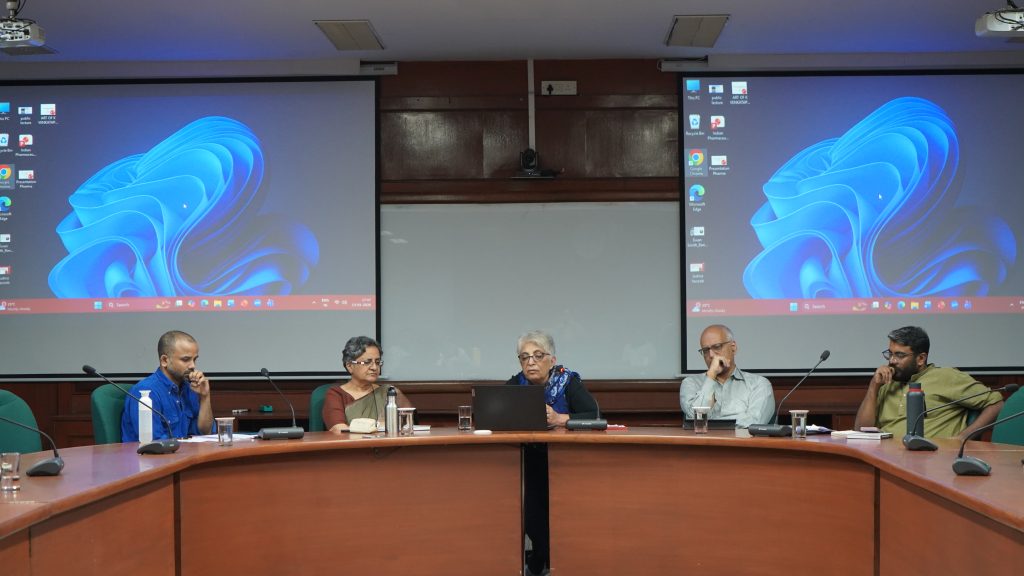 The NLSIU Library Committee organised a panel discussion with Prof. (Dr.) Meera Nanda on January 13, 2026. The discussion focussed on Dr. Nanda’s recent work on the convergences between Hindu nationalism and postcolonial theory.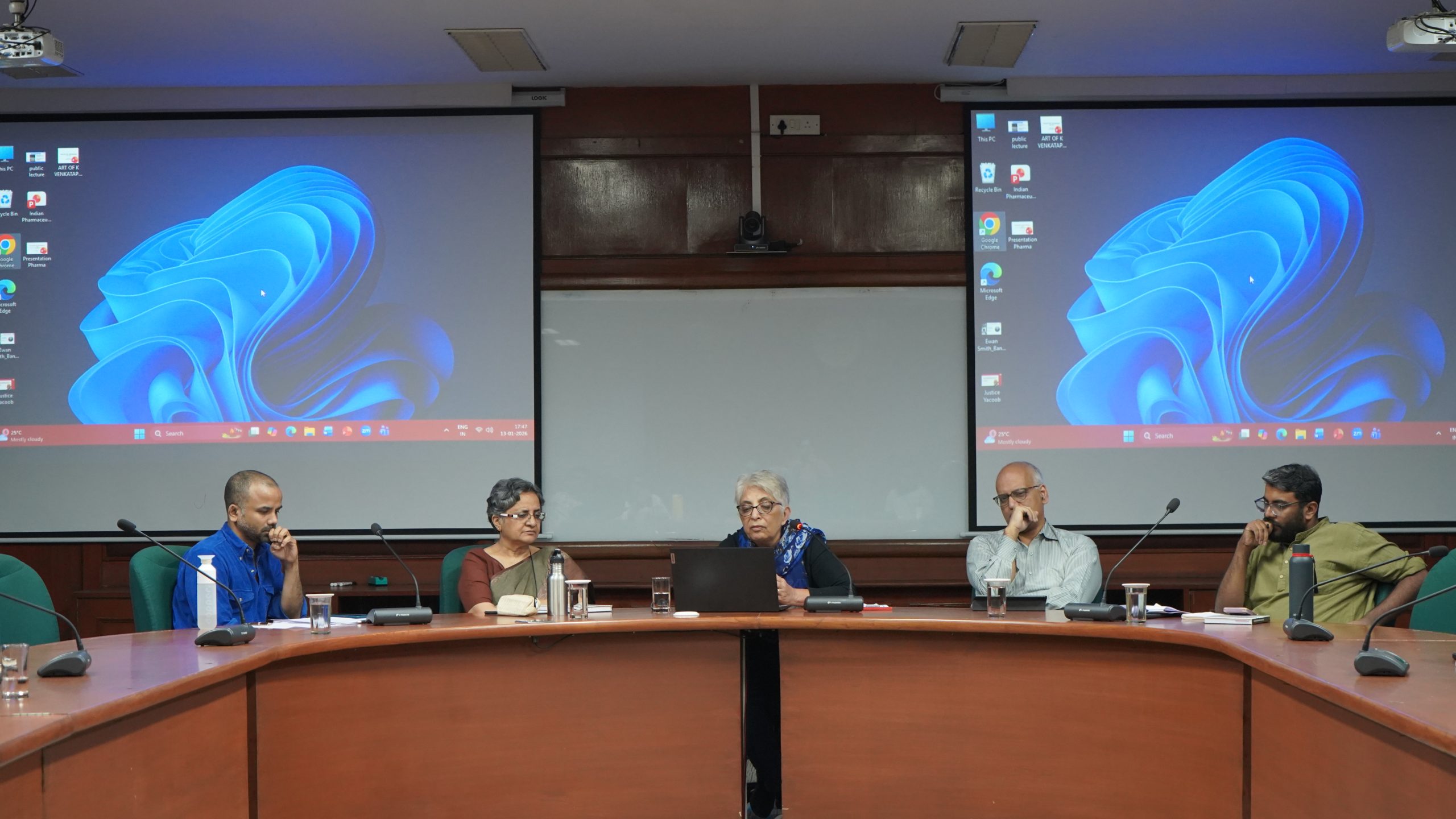
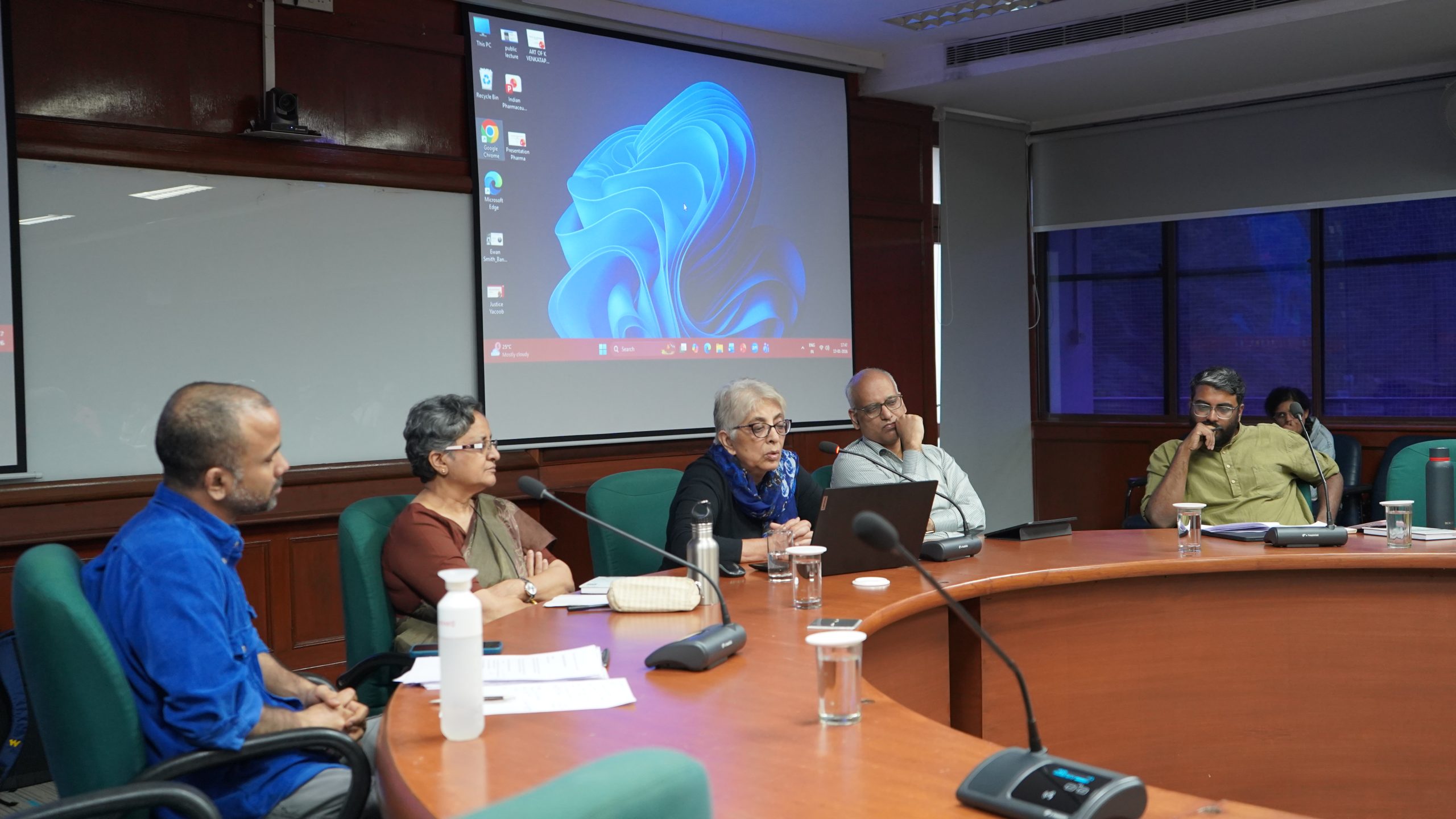
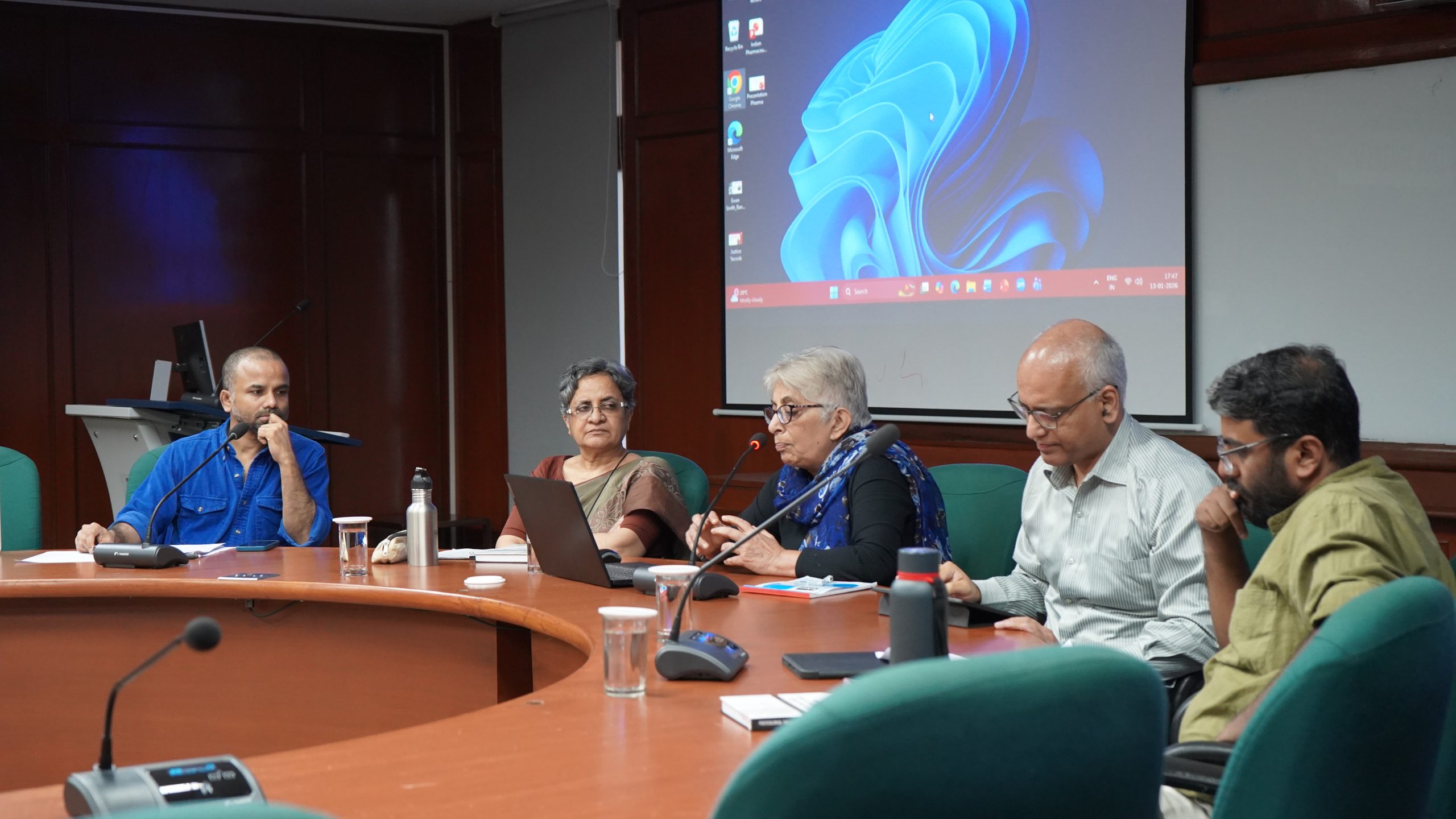
 The Green Room invites you to a play reading of The Coffin is Too Big for the Hole by Kuo Pao Kun (a short one-act play) on January 7, 2026. The session will take place from 5 –7 pm and take the form of a table read followed by a discussion.
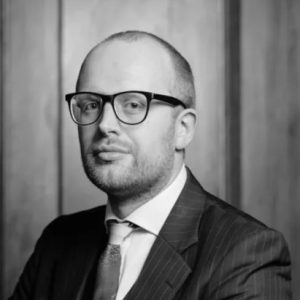 Dr. Ewan Smith joined UCL Laws as Associate Professor of Public Law in 2022. Prior to that he was a Fellow of Christ Church, Oxford, the Shaw Foundation Junior Research Fellow at Jesus College, Oxford, and an Early Career Fellow at the Bonavero Institute of Human Rights. Ewan read law at Oxford, at the University of Paris and at Harvard Law School. In 2023 Ewan was a Hauser Fellow at New York University Law School and in 2024 he was a Visiting Professor at Faculty of Law of the University of Bologna. In 2026 he will be a visiting professor at the National University of Singapore. He has previously worked at Peking, Tsinghua and Renmin Universities in China and between 2005 and 2015 he worked for the UK Foreign Office. Ewan’s work considers how political rules govern powerful institutions, how law shapes foreign relations, and compares the constitutional orders of China, the UK and the United States. He is admitted to practice in New York
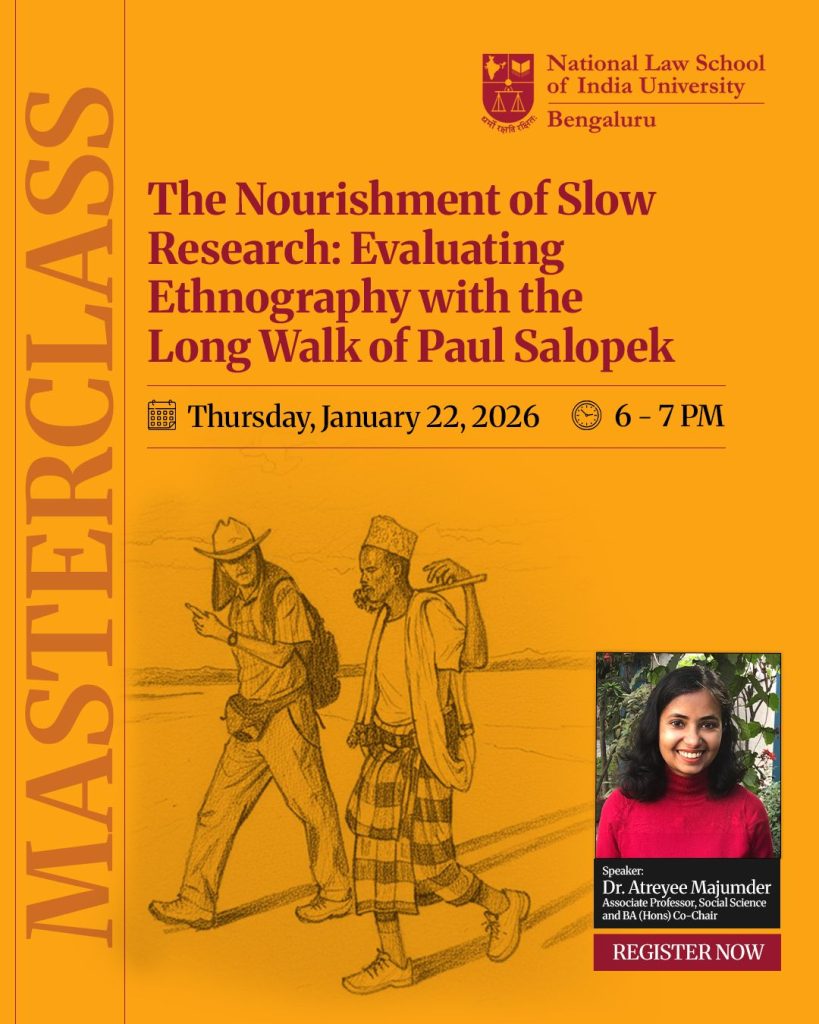 Session I: ‘The Nourishment of Slow Research: Evaluating Ethnography with the Long Walk of Paul Salopek’ with Dr. Atreyee Majumder, NLS BA (Hons) Co-Chair
 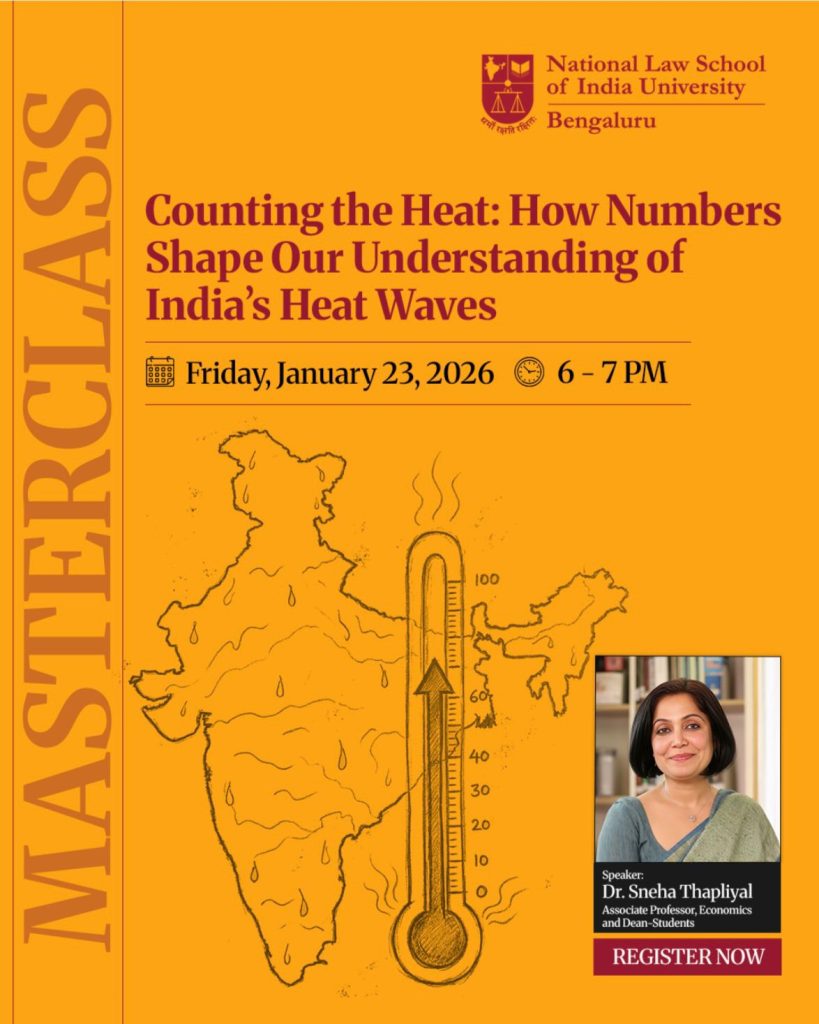 Session II: ‘Counting the Heat: How Numbers Shape Our Understanding of India’s Heat Waves’ with Dr. Sneha Thapliyal, Associate Professor of Economics
 Astha has over a decade of public policy and strategy consulting experience, with a focus on the use of technology for welfare. At Aapti, Astha leads the Data Economy Lab, a vertical established to research and test new methods of data sharing, data stewardship and governance. Her recent work is focused on participative governance of data, and its use for building collaborative AI, through collective governance methods such as cooperatives. She serves on the advisory boards of the Data Trust Initiative (Cambridge University) and Indian Urban Data Exchange (IUDEX). Prior to Aapti, Astha worked with Future State, Azim Premji’s Philanthropic Initiatives, Dalberg Global Development Advisors, the Planning Commission, the Government of India and the Self-Employed Women’s Association. She’s a visiting fellow at the Ostrom Workshop (Indiana University), a two-time TEDx speaker, and a Global Governance Futures Fellow 2018-19. Astha’s writing has been published in the Mint, Hindu, and Deccan Herald among others.
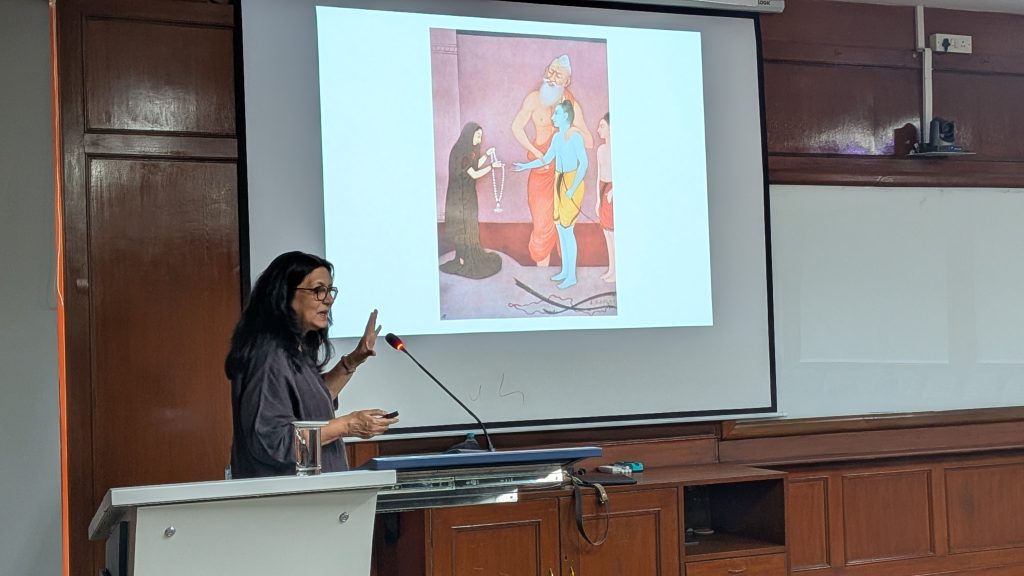 ‘Looking at Karnataka’s First Modern Artist K. Venkatappa’ by Pushpamala N
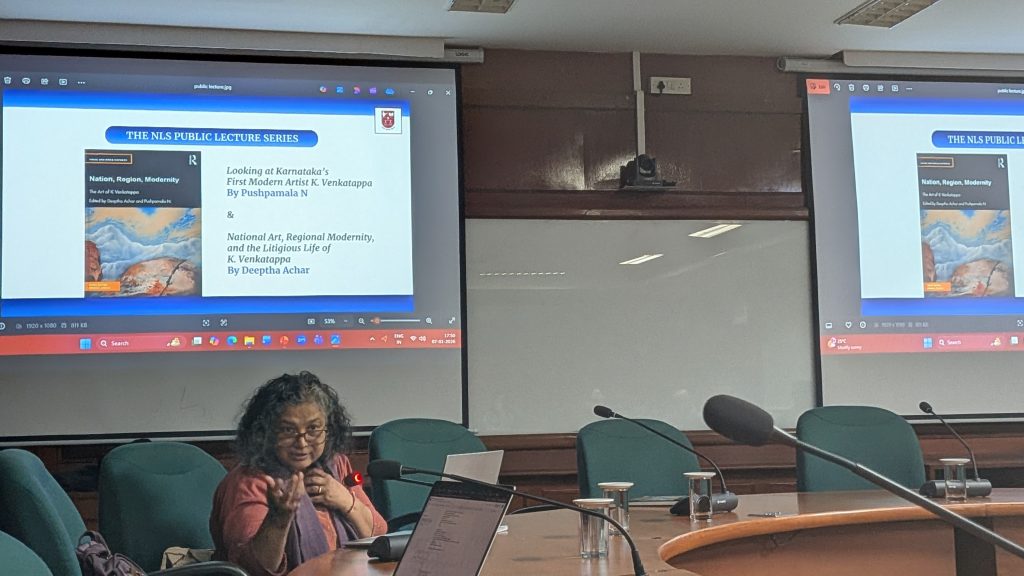 ‘National Art, Regional Modernity, and the Litigious Life of K. Venkatappa’ by Deeptha Achar