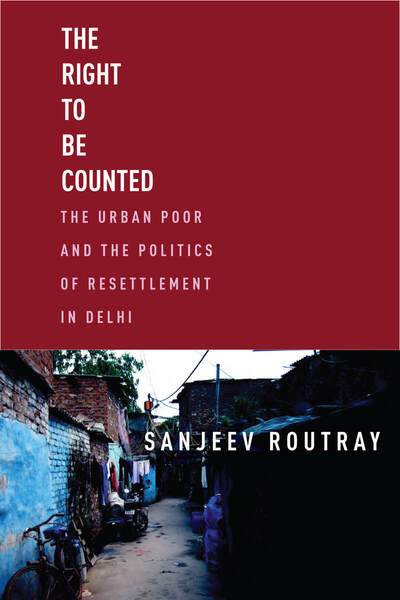
In the last 30 years, Delhi, the capital of India, has displaced over 1.5 million poor people. Resettlement and welfare services are available—but exclusively so, as the city deems much of the population ineligible for civic benefits. The Right to Be Counted examines how Delhi’s urban poor, in an effort to gain visibility from the local state, incrementally stake their claims to a house and life in the city. Contributing to debates about the contradictions of state governmentality and the citizenship projects of the poor in Delhi, this book explores social suffering, logistics, and the logic of political mobilizations that emanate from processes of displacement and resettlement. Sanjeev Routray draws upon fieldwork conducted in various low-income neighborhoods throughout the 2010s to describe the process of claims-making as an attempt by the political community of the poor to assert its existence and numerical strength, and demonstrates how this struggle to be counted constitutes the systematic, protracted, and incremental political process by which the poor claim their substantive entitlements and become entrenched in the city. Analyzing various social, political, and economic relationships, as well as kinship networks and solidarity linkages across the political and social spectrum, this book traces the ways the poor work to gain a foothold in Delhi and establish agency for themselves.
About the Speaker
Dr. Sanjeev Routray is an Assistant Professor in the Institute of Asian Studies, Universiti Brunei Darussalam. He completed his PhD in sociology at the University of British Columbia. Dr. Routray is a sociologist-anthropologist, critical urbanist, and migration specialist of South Asia and beyond. His areas of expertise include urban poverty, political and legal mobilizations, transregional migration, and caste and labor market negotiations. He is the author of The Right to be Counted: The Urban Poor and The Politics of Resettlement in Delhi (2022, Stanford University Press) and his articles have appeared in leading journals including International Journal of Urban and Regional Research, Urban Studies, and City: Analysis of Urban Change, Theory, and Action. Dr. Routray has received fellowships from the Urban Studies Foundation (UK), The Foundation for Urban and Regional Studies (UK), Zeit-Stiftung Ebelin und Gerd Bucerius Foundation (Germany), International Development Research Centre (Canada), and the Hari Sharma Foundation for his research and writing.
PACT is an international collaboration, that aims to produce cutting-edge scholarship on India’s constitutional founding, establish a new digital archive on Indian constitution making, and learn from historical and contemporary public engagements with the Constitution. Led by SOAS University of London, PACT collaborators include the Universities of Oxford, York, the Centre for Law and Policy Research, Bengaluru and NLSIU.
Theme
The conference will explore Indian constitution-making as a process of reaching pluralist agreement between contending actors and constitutional transformation over time, through three lines of enquiry
First, what were the types of counter-majoritarian proposals put forward by advocates of individual freedoms and group rights in India between 1928-50? What were the constitutional alternatives offered by those outside the Constituent Assembly?
Second, what was the relationship between the procedures adopted in the Indian Constituent Assembly’s deliberations, and its outcomes with regard to pluralism? How did the division of the Assembly’s work into various committees, decision making processes and the timing and sequencing of proposals enable or hinder the accommodation of diversity?
Third, what forms of participation and civic engagement are enabled by the extensive constitutional archive available today? In what ways is this archive used to bolster contemporary appeals to constitutional values and principles?
Keynote Speakers
Hon’ble Mrs. Justice B. V. Nagarathna, Supreme Court of India
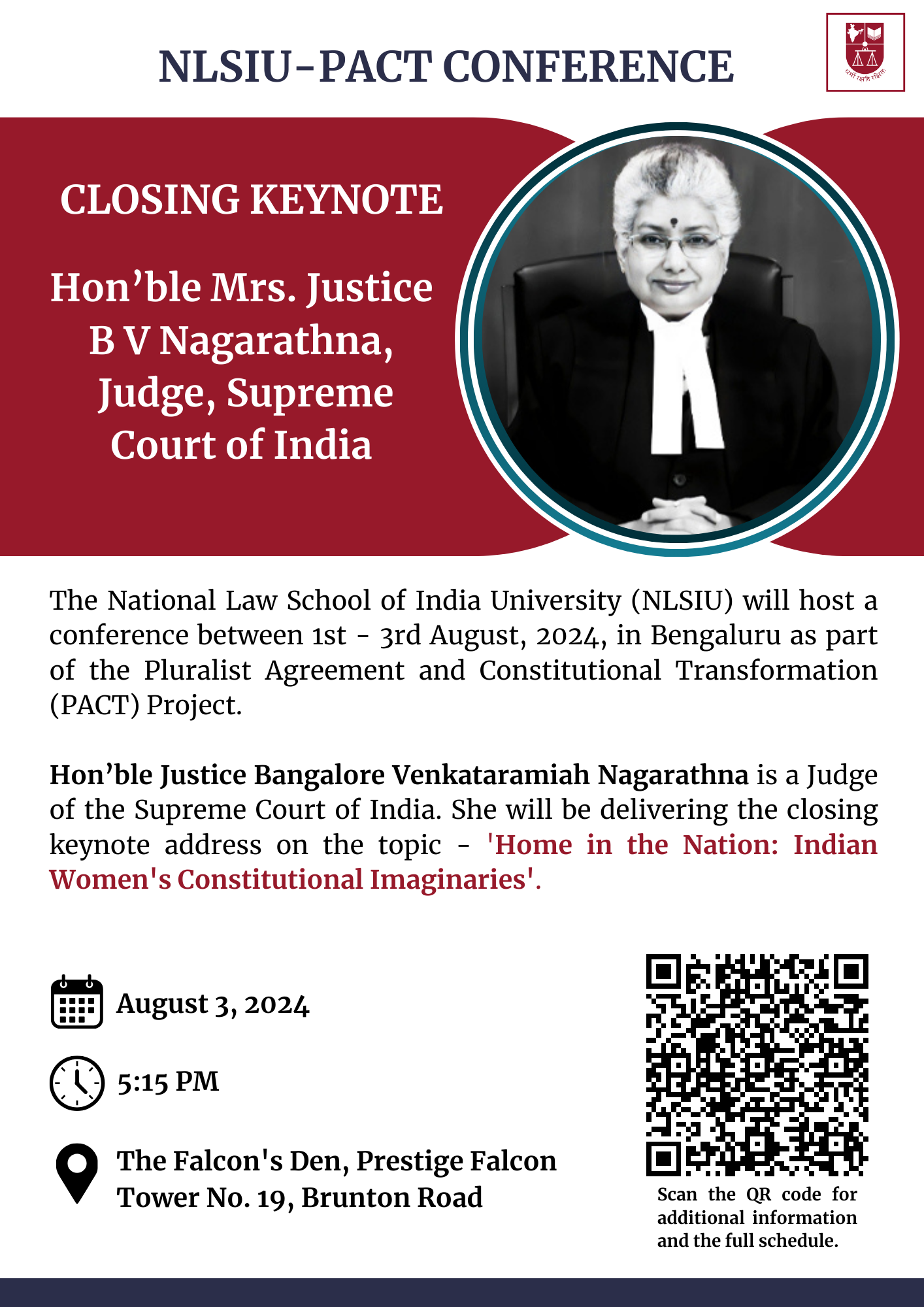
Hon’ble Mrs. Justice B V Nagarathna will deliver the conference closing keynote on the topic ‘Home in the Nation: Indian Women’s Constitutional Imaginaries’. This closing keynote address will be delivered on August 3, 2024, 5 PM, at The Falcon’s Den, Prestige Falcon Tower No. 19, Brunton Road. Hon’ble Justice Bangalore Venkataramiah Nagarathna is a Judge of the Supreme Court of India. She served as a Judge of the Karnataka High Court from 2008 to 2021. She is in line to become the first female Chief Justice of India in 2027. The poster for this session can be accessed here.
Prof. Pratap Bhanu Mehta
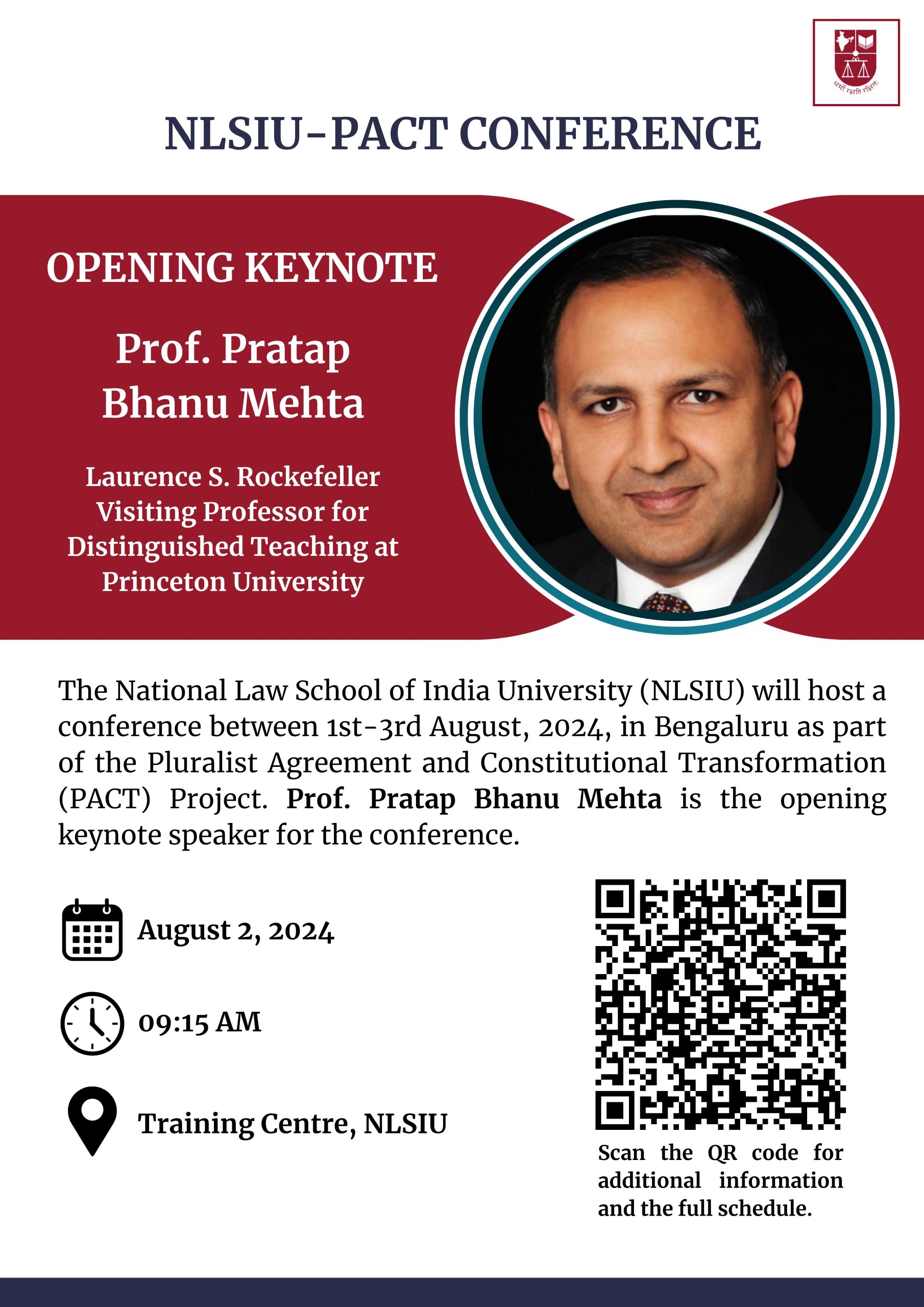
Pratap Bhanu Mehta is the Laurence S. Rockefeller Visiting Professor for Distinguished Teaching at Princeton University. Prof. Pratap Bhanu Mehta will deliver the opening keynote address on August 2, 2024, 9:15 AM, at the NLSIU Training Centre. He was previously Vice-Chancellor of Ashoka University, and President, Centre for Policy Research, Delhi. He has previously taught at Harvard, Ashoka University, Jawaharlal Nehru University and has been Global Faculty at NYU Law School. He has published widely in political theory, history of ideas, Indian constitutional law and politics in India. He is the author of The Burden of Democracy (Penguin 2003) and has produced several edited volumes. He is (most recently) co-editor with Madhav Khosla and Sujit Choudhary of The Oxford Handbook to the Indian Constitution. His forthcoming work looks at philosophical ideas about religion in 20th-century India. The poster for this session can be accessed here.
Conference Panels
The conference will comprise 5 panels that will be organised on August 2nd (full day) and August 3rd (first half) at the NLSIU campus.
Day 1: August 2, 2024
Venue: Training Centre, NLSIU
9 am to 9.05 am – Welcome and Introduction | Sudhir Krishnaswamy, NLSIU and Rochana Bajpai, SOAS University London
9.05 am to 10.00 am – Opening Keynote | Pratap Bhanu Mehta, Princeton University
10.15 am to 11.45 – Panel I : Studying India’s Constitutional Founding: Methods and Archives
(Discussant: Sidharth Chauhan, NLSIU)
Paper Presentations: Quantitative Analysis of Borrowing in the Indian Constitution | Sudhir Krishnaswamy, NLSIU Our Constitution: The Archive of Constitutional Expectations | Ornit Shani, Haifa University and Rohit De, Yale University Constitutional Debates in the Indian Journal of Political Science in the 1940s | TT Arvind, York Law School
12.00 to 1.30 pm – Panel II: Key Constitutional Choices: Democracy, Federalism and Social Transformation (Discussant: Karthick Ram Manoharan, NLSIU)
Paper Presentations: Indian Constitution and Indian Democracy: A Divergent History | Shruti Kapila, Cambridge University, Visiting Professor, NLSIU India’s Directive Principles: Clarifying Origins and Fate in the Early Republic | Vineeth Krishna, Centre for Law and Policy Research From Federation to National State: Self, Other and Stranger in the Indian Founding | Moiz Tundawala, Oxford University Making the Twain Meet: India, Kashmir, and the Constitutionalizing of Difference | Rouf Dar, University of Kashmir
2.30 to 4.30 pm – Panel III: Forgotten Histories of Constitution Making (Discussant: Sanjay Jain, NLSIU)
Paper Presentations:
Implications of Introducing Gender into the History of Constitution-making in India | Achyut Chetan, St Xaviers University Beyond the Hollow Crown: The Chimeric Constructions of Puddukottai’s Reform Efforts | Bharath Gururaghavendran, New York University Exclusion of Pasmanda Muslims and Dalit Christians from the Scheduled Caste Quota | Arvind Kumar, Royal Holloway, Universtiy of London (Virtual) The National Archives and Indian Constitutional History: Perspectives and Experiences | Sarfaraz Hamid, Archival Researcher The Quill Project: Modelling the Negotiation of the Indian Constitution | Lauren Davis, University of Oxford
Day 2: August 3, 2024
Venue: Conference Panels at Training Centre, NLSIU | Keynote at Prestige Falcon, Brunton Road
9.30 am to 11.00 am – Panel IV: Minority Rights in Indian Constitutionalism
(Moderator: Anwesha Ghosh, NLSIU; Discussant: Salmoli Choudhuri, NLSIU)
Paper Presentations: Minorities and the Un-making of Indian Democracy | Aparna Chandra, NLSIU Constitution-Making and the Cultural & Educational Rights of Minorities: The Statement of a New Research Agenda | Adrija Ghosh, Oxford University Sanatanist Claims to the Constituent Assembly of India | Manas Raturi, Oxford University (Virtual) A Brief History of the Scheduling Discourse in late-Colonial India (1918-1950) | Saagar Tewari, Jindal Global University Sieving Silence: The Archive of Indian Constitutional History | Kanika Gauba, Univeristy of Birkbeck (Virtual)
11.15 am to 1.15 pm – Panel V: Deliberative Institutions in Indian Constitutionalism
(Discussant: Aishwarya Birla, NLSIU; Moderator: Megha Sharma, NLSIU)
Paper Presentations:
Rethinking Hegemony through the Indian Constituent Assembly | Rochana Bajpai, SOAS University of London
‘The Indian Parliament: Deliberation and Representation’ | Udit Bhatia, University of York
Parliament and Difference: Parliamentarianism and Development in a Divided Society | Sandipto Dasgupta, The New School for Social Research
The Radical Democratic Party (RDP) and Parliamentary Constitutionalism | Tejas Parasher, University of California, Los Angeles (Virtual)
Quasi-Democratic Imaginations: Envisioning the Parliamentary Opposition in the Constituent Assembly| Rupak Kumar, Vellore Institute of Technology
1.15 pm to 1.30 pm – Closing Remarks and Thanks | Rochana Bajpai and/or Sudhir Krishnaswamy
5.15 pm to 6.30 pm – Closing Keynote | Honourable Justice Nagarathna, Supreme Court of India, Prestige Falcon Towers
Contact
For any queries, reach out to
Please note: Given the limitations on seating capacity, all panels including the opening keynote address will accom0date guests/attendees on first come, first served, basis.
Prof. Nivedita Menon, Centre for Comparative Politics and Political Theory, Jawaharlal Nehru University, Delhi, will deliver a special faculty seminar on Hindu majoritarianism and the construction of “religion” on July 10, 2024, at 4 pm. NLS Faculty, Dr. Sushmita Pati will be the discussant.
About the Speaker
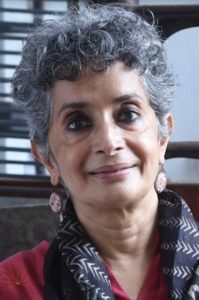
Nivedita Menon is a Professor at the Centre for Comparative Politics and Political Theory, Jawaharlal Nehru University, Delhi. Her latest book is Secularism as Misdirection: Critical Thought from the Global South (Permanent Black and Duke University Press 2023). Apart from research papers in Indian and international journals, her previous books are Seeing like a Feminist(2012/updated 2nd Edition 2022), Recovering Subversion: Feminist Politics Beyond the Law (2004); and (co-written) Power and Contestation: India after 1989 (2007/2nd Edition 2014). She is a regular commentator on contemporary issues on the collective blog kafila.online (of which she is one of the founders). She has translated fiction and non-fiction from Hindi and Malayalam into English, and from Malayalam into Hindi, and received the AK Ramanujan Award for translation instituted by Katha.
Abstract
For the session she has shared two chapters from her book Secularism as Misdirection. Critical Thought from the Global South that focuses specifically on India, hoping to draw out implications for wider contexts. Chapter 2 examines ascendant Hindu supremacism as a state project in India, it tries to understand the ways in which the construction of religion functions under conditions of majoritarianism. In addition, three key elements in the co-construction of religion and the state are considered – the Essential Religious Practices test; the idea of religious institutions/deities as juristic persons; and the state’s role in managing the finances of religious institutions.
Chapter 3 focuses on caste, one of the critical elements in this region, which is obscured by the celebration and practice of secularism. This chapter examines the millennia-old project of Brahminism in this territory, now called India, of producing a community that abides by the caste system and accepts Brahminism as the dominant ideology. The modern project of Hindutva is only the current phase of a process that began with the advent of Vedic people Aryans into this land mass. Here she focuses on Hindutva’s continuity with the millenia old project rather than the breaks. Rejecting the claim of Hindutva that Hindus are the majority in India requires mainstream Left, secular, and feminist politics to reorient itself through a serious engagement seriously with Dalit Bahujan scholarship and life worlds, and to learn from these.
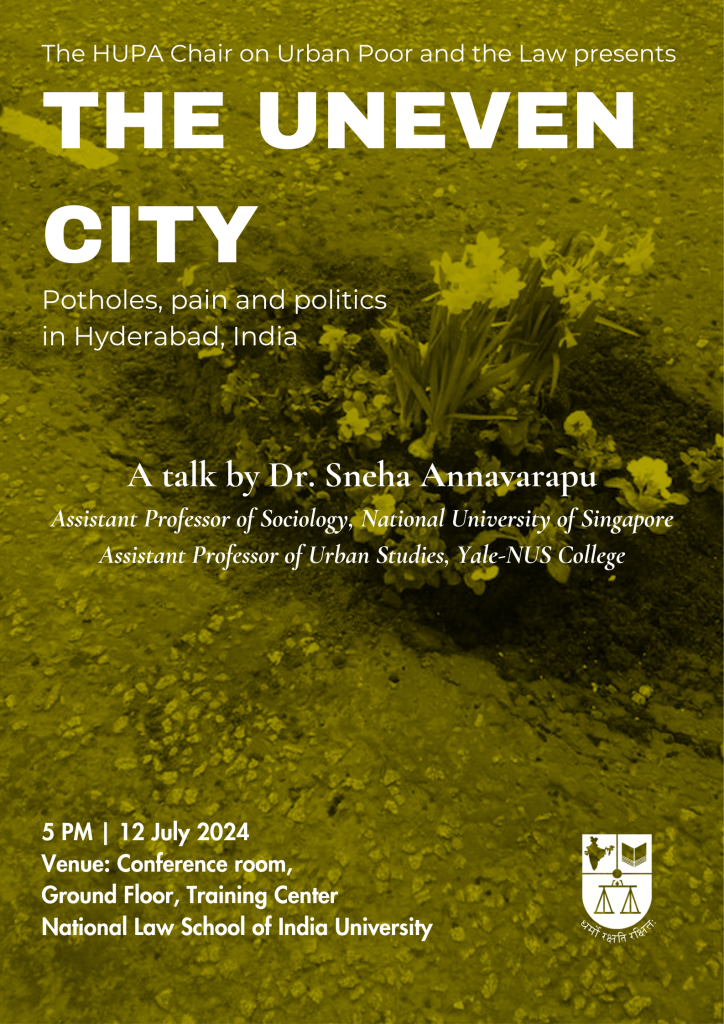
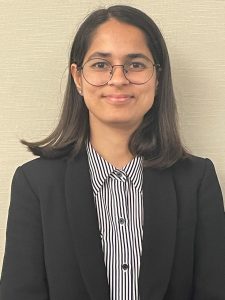
Dr. Sneha Annavarapu, Assistant Professor of Sociology, National University of Singapore, and Assistant Professor of Urban Studies, Yale-NUS College.
Abstract:
In this paper, I draw on the embodied experience of driving into potholes and on bumpy roads in Hyderabad and show how road surfaces become the literal terrain on which political sensibilities are shaped. Drawing on ethnographic data from 2017-2022, I analyze how potholes shape driving dispositions in a city that is attempting to brand itself as a “world-class” city. I show that far from being just physical interruptions on the surface of the road, potholes engender political subjectivities in three ways: one, they generate, sustain, and institutionalize narratives of state corruption; two, through their capacity to hurt, injure, and even kill certain motoring bodies, potholes enable an experience of inequality in the register of pain and risk; and three, potholes spawn citizen engagement and claims-making. Through a discussion of these three processes, I show how and why the banal pothole becomes an aperture through which to view the desires, discomforts, and disappointments in urban India. Ultimately, I argue that taking sensation and tactility into account clarifies how social inequality operates through urban infrastructure.
NLSIU and the Bangalore International Centre (BIC) are organizing a panel discussion on July 12, 2024, from 6.30 pm to 8.00 pm at the BIC, Domlur.
This panel discussion is a conversation between two authors who also share a teacher-student relationship. Prof. Nivedita Menon will speak on her latest book, Secularism as Misdirection, while Dr. Debangana Chatterjee, her student from Jawaharlal Nehru University, will present her first book, Lives of Circumcised and Veiled Women. The intellectual pursuits of two individuals, which converged in classroom discussions once, complete a full circle of knowledge creation.
The conversation aims to probe religion and secularism using gender as the focal point. Menon’s title alludes to perspectives from the global South and India. In her argument, secularism performs a “misdirection” as in the performance of a magic trick. It simultaneously hypervisiblises women and religion and obscures caste, capitalism, and the non-individuated, non-rational self. Chatterjee’s work sheds light on the politics of representation and the process of exoticising women’s bodies in knowledge production; presenting the politics which cloaks the ‘misdirection’. It brings out the intricacies of representational discourses around cultural practices of female circumcision and Islamic veiling.
The conversation will be moderated by Dr. Rinku Lamba, followed by a Q&A session with the audience.
About the Speakers
Prof. Nivedita Menon
Nivedita Menon is a Professor at the Centre for Comparative Politics and Political Theory, Jawaharlal Nehru University, Delhi. Her latest book is ‘Secularism as Misdirection: Critical Thought from the Global South’. Apart from research papers in Indian and international journals, her previous books are ‘Seeing like a Feminist’, 2012, ‘Recovering Subversion: Feminist Politics Beyond the Law’, 2004; and (co-written) ‘Power and Contestation: India after 1989’, 2007. She has translated fiction and non-fiction from Hindi and Malayalam into English, and from Malayalam into Hindi, and received the AK Ramanujan Award for translation instituted by Katha.
Dr. Debangana Chatterjee
Dr. Debangana Chatterjee is an assistant professor and currently, the co-director of the Centre for Women and the Law (CWL) at the National Law School of India University (NLSIU), Bengaluru. In her doctoral thesis, awarded at the Centre for International Politics Organization and Disarmament (CIPOD), Jawaharlal Nehru University — she has tried to locate the existing Indian discourse surrounding the practices of Female Circumcision and Islamic veiling, viewed through the larger frame of international politics. Based on the thesis, her first published book, titled ‘Lives of Circumcised and Veiled Women‘ was published by Routledge in 2023. In May 2023, she successfully concluded a short-duration research project (2022-23) gauging the impact of the COVID-19 pandemic on home-based sex workers in Bengaluru and identifying the policy lacunae, under the aegis of ICSSR- Southern Regional Centre (SRC).
Dr. Rinku Lamba
Dr. Rinku Lamba is an associate professor at the National Law School of India University (NLSIU), Bengaluru. She previously held visiting faculty positions at Humboldt University, and University of Wurzburg in Germany, and served as an instructor at the University of Toronto. She was a Max Weber Fellow at the European University Institute, a Harold Coward Fellow at the University of Victoria, and held fellowships at the University of Sydney and the Australian Catholic University, Sydney. She was also the Lansdowne Visiting Scholar in Religious Studies at the University of Victoria in Canada in 2019. In 2022, she received the Dalai Lama Fellowship for Nalanda Studies from the Foundation for Universal Responsibility.
The National Human Rights Commission Chair at NLSIU is presenting a special lecture on “Ties of Brotherhood: Custodial Deaths and the Law in India” with Advocate and Researcher Megha Bahl on Wednesday, 10th July, at 5.30 pm.
About the speaker
Megha Bahl is a Delhi-based High Court and trial court lawyer who has worked on both prosecution and defence within the criminal legal system. She has undertaken extensive research and legal aid on concerns of democratic rights, particularly those relating to police violence. Megha is a Fulbright scholar who recently completed her Master’s in Law from the University of Texas at Austin. At UT Austin, she undertook research with the Prison and Jail Innovation Lab, a research and advocacy group at the LBJ School of Public Affairs, on custodial deaths and oversight conditions for those incarcerated in the state of Texas.
Abstract
Custodial deaths are universally recognized as a violation of fundamental and human rights, but continue to persist unabated within the police and prison systems of the country. According to the last available National Human Rights Commission Annual Report, it received 2543 intimations of custodial deaths in police, judicial and (para)military custody within the year 2021-22 itself. Recent interventions have proposed technological solutions to the challenge of custodial violence, for instance, through the mandatory installation of CCTV cameras in police stations. This talk aims to bring attention to the systemic challenge of “ties of brotherhood”, in the words of the Supreme Court in DK Basu v. State of West Bengal (1997), which breeds impunity for such forms of police violence. Here, ties of brotherhood refer to legal and organizational cultures within police organizations which shield perpetrators and impede access to justice. The talk relies on two case studies of custodial deaths from Delhi to throw light on the specific ways in which these ties of brotherhood operate among the police organizations, and the capacity of the Law and legal processes to constrain such organizational cultures.
The idea of a research talk is about discussing how the book was researched, methodology and writing. So this will not be a “talk” in the conventional sense. Attendees are all expected to read the introduction to his book before coming for the talk, which is available here. The talk would happen on campus in person, and in hybrid mode.
Abstract
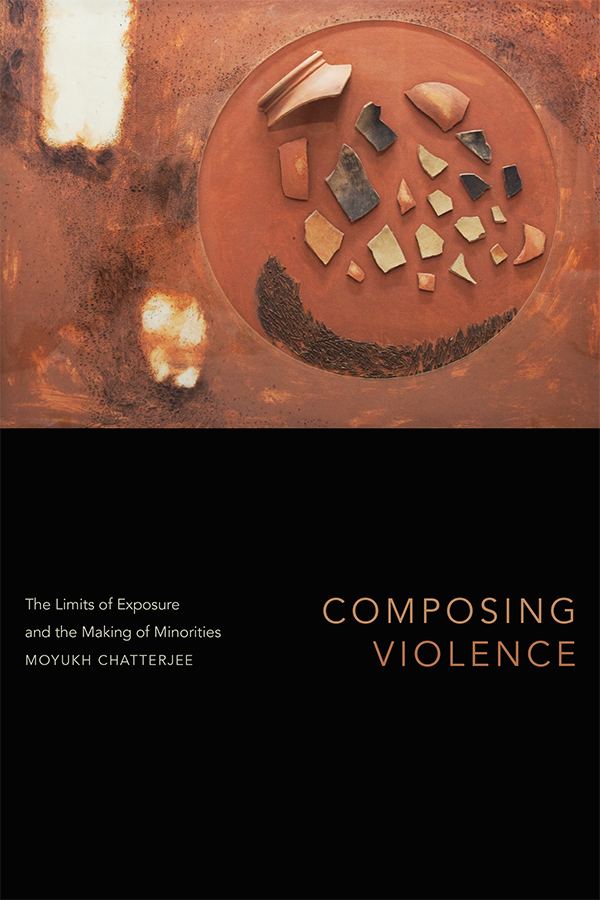
To compose violence is to describe violence as a constitutive force that produces and reproduces the majority and the minority – on the street, in the courtroom, in the police archive, and within mainstream media. In my work on the afterlives of Gujarat 2002, I examine the role of legal archives, everyday police reporting, and courtroom rituals in the production of new kinds of majorities and minorities. By moving from exposure to composition – the power of violence to produce new attachments, subjects, and subjectivities – we will discuss two related questions: What scholarly work is possible when violence is not repressed, not located at the margins of the state, and not even disguised by the participants? What forms of everyday legality transform anti-minority violence into durable order? We will focus on police archives, legal activism, and mainstream media coverage, to understand the role of everyday law in sustaining supremacist regimes.
About the Speaker
Dr. Moyukh Chatterjee is a political and legal anthropologist and his work explores the afterlives of political violence. He teaches in the department of social anthropology at the University of Edinburgh. His book Composing Violence: The Limits of Exposure and the Making of Minorities (Duke University Press, 2023) examines how political violence against minorities acts as a catalyst for radical changes in law, public culture, and statecraft. More broadly, his work explores the limits of the politics of exposure to understand majoritarian politics and anti-minority violence in India and beyond.
Over the last decade, he has been trying to understand the relationship between crowds and power, impunity and state formation, and the law and supremacist regimes as part of a broader effort to grasp the role of violence within liberal democracies. His current research examines the everyday life of far-right supremacist regimes, including the life stories of precarious young men who join far-right organisations, the creation of muscular, religious publics, and the relationship between authoritarian rule and public religiosity.
We are excited to announce that Prof. Nivedita Menon, Centre for Comparative Politics and Political Theory, Jawaharlal Nehru University, Delhi, will deliver the MK Nambyar Annual Lecture for 2024 on 9th July. NLSIU Faculty, Dr. Salmoli Choudhuri will be the moderator.
The talk will be delivered on the topic ‘Insurgent constitutionalism and Radical frames of citizenship’ from 5 PM to 6.30 PM, in the Krishnappa Hall, OAB – 201, NLSIU.
About the Speaker
Nivedita Menon is a Professor at the Centre for Comparative Politics and Political Theory, Jawaharlal Nehru University, Delhi. Her latest book is Secularism as Misdirection: Critical Thought from the Global South (Permanent Black and Duke University Press 2023). Apart from research papers in Indian and international journals, her previous books are Seeing like a Feminist(2012/updated 2nd Edition 2022), Recovering Subversion: Feminist Politics Beyond the Law (2004); and (co-written) Power and Contestation: India after 1989 (2007/2nd Edition 2014). She is a regular commentator on contemporary issues on the collective blog kafila.online (of which she is one of the founders). She has translated fiction and non-fiction from Hindi and Malayalam into English, and from Malayalam into Hindi, and received the AK Ramanujan Award for translation instituted by Katha.
About the Session
I will consider two themes in the lecture – constitutionalism as a radically transformative framework, and an expanded notion of citizenship. A Constitution is usually seen as a legal document that embodies a new dispensation or structure of power and which becomes a crucial reference point in the resolution of disputes between groups. However, that does not exhaust what Constitutions do. The hope inspired by the idea of a Constitution as the basis of a democratic state is as vibrant in the twenty-first century as in the mid twentieth, when the first wave of decolonisation took place across the global South. A comparison of Chile’s draft Constitution of 2022 and India’s enacted in 1950 yields some productive insights. We will also consider two movements in India that invoke constitutional morality – the queer movement and Pathalgadi. In addition we will consider the recently enacted Uttarakhand Uniform Civil Code as a violation of every principle of both consitutionalism and citizenship. The lecture will also question the idea of citizenship as inherently emancipatory, and consider what citizenship can look like when freed from the barbed wire borders of nation states.
As a part of the International Archives Week from June 3rd to June 9th 2024, NLSIU will host an online webinar titled “In the Dream House: Examining the New Archival Turn in India” by Ammel Sharon, on June 7 (Friday), 2024. This marks the sixth International Archives Week organized by the International Council of Archives. This year’s theme is #CyberArchives.
About the Lecture
This illustrated talk will introduce archives in a three-fold manner: as records, institutions and spaces. It will show similarities, and mark some differences, between archives and allied record-keeping sites like libraries and museums. Second, it will make a few observations on archives of independent India based on recent scholarship. Finally, it will discuss the approach of the Queer Archive for Memory, Reflection and Activism (QAMRA) at NLSIU as a significant ‘living archive’ of gender and sexuality.
About the Speaker
Ammel is Project Director and Lead Archivist at the Queer Archive for Memory, Reflection and Activism (QAMRA) at NLSIU. She is also a PhD candidate in History at the Centre for Studies in Social Sciences, Calcutta. Her dissertation is titled Literature as Recovery: The Public Life of Text Criticism in Kannada.
At QAMRA, she brings her interests in history and higher education to the queer archive at NLSIU. She supervises archival processes including acquisition, documentation and digitization of the collections. Her priorities are to deepen QAMRA’s presence among queer individuals and communities in India, as well as on the NLSIU campus among faculty members, library staff and students through events and collaborations, to foster exchange with academic and archival institutions, fundraise to ensure stability crucial for the continuity of QAMRA’s plans, and work towards community-focused public engagement and research publications.
With RVS Sundaram, she has translated an eleventh century Kannada poem, Gadāyuddham, as The Duel of the Maces (Manohar 2018, Routledge 2020) and a tenth century Kannada treatise, Chandombudhi, as The Ocean of Prosody (Central University of Karnataka 2020). Recently, she co-authored an open-access info-booklet on pollinators, Native Bees and Pollination in the Puducherry Bioregion (IFP 2022). Her forthcoming publications include an article on Kannada typography for the Book History in India series Vol. 4 (Orient Blackswan), and an essay on abstinence for an anthology on South Asian friendships (Yoda Press). Some of her collaborative work can be found on www.understory.in
Please note: The webinar is open to all, with no registration fee. The webinar link and joining details will be sent to your registered email address. Register here.
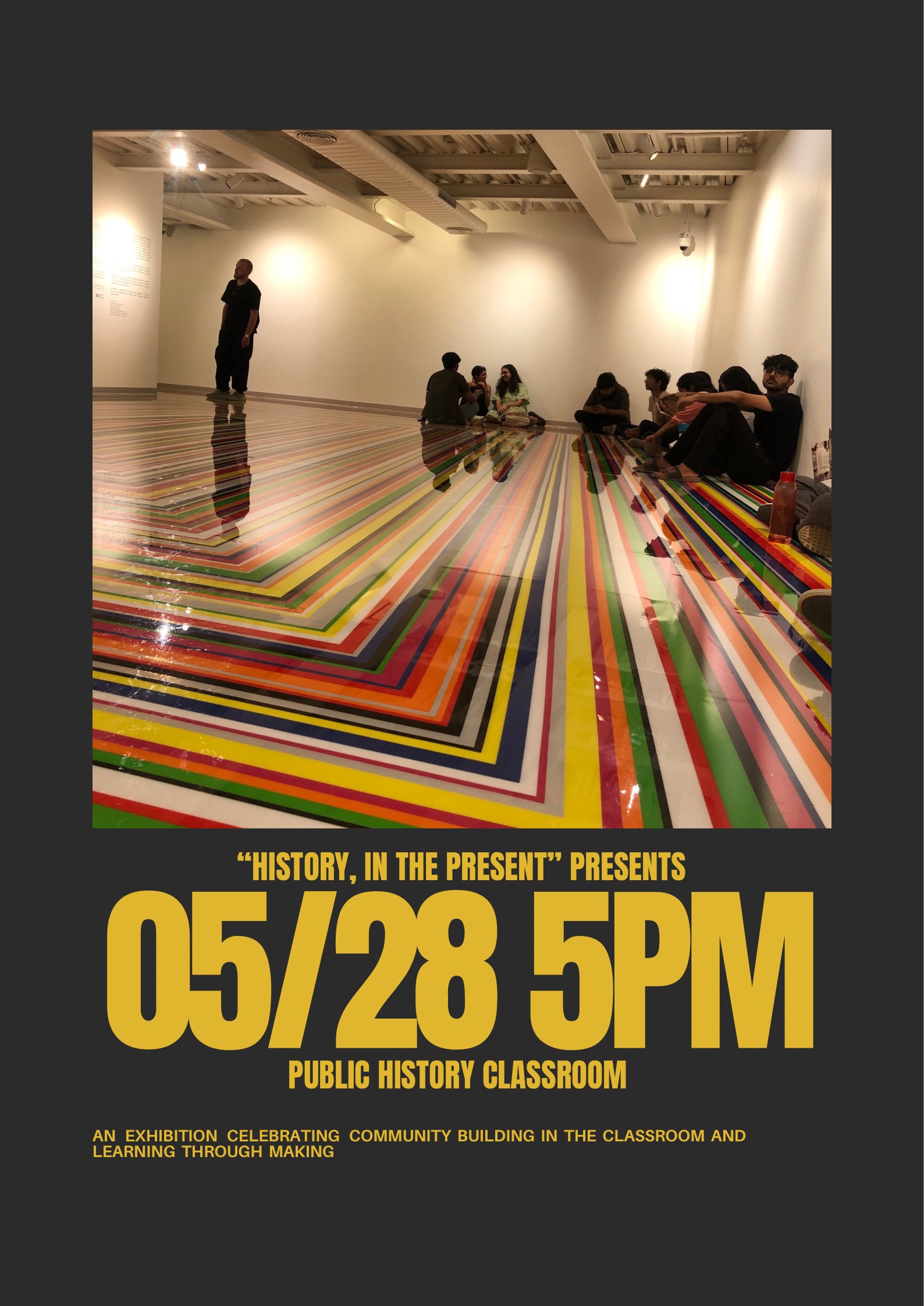
The class exhibition of the “History, in the Present” seminar at NLSIU, opens on Tuesday, May 28, between 5-6 PM at OAB 105. This preview will include a screening of the flagship exhibit followed by celebrations and reflections on the work done by students and the instructor Dr. Samyak Ghosh, during the trimester.
Following the preview, for the next two days, multiple exhibits are open to viewing at various locations across the campus, where those viewing can interact with the exhibits and share their reflections.
On May 30 (Thursday), an open house history telling event will be organized in the OAB 105, between 2:30-4:40 PM. The event also marks the closing of the exhibition.
Introduction
NLS students interacting with Jim Lambie’s Zobop exhibit.
The theme for the class exhibition of the Public History Seminar, AY 2024-2025, is “Anti-classroom Classroom”. Through several exhibits displayed at multiple sites throughout the NLSIU campus the students along with the instructor will explore how we can break down and rethink the classroom as a space and an idea.
Our point of divergence is the traditional classroom where the instructor and the institution are merged as sites of authority. “Anti-classroom Classroom” is not necessarily a critique of the traditional classroom but an effort to imagine and practice alternative forms of pedagogy that are in alignment with community-based learning and making and knowing as co-constitutive practices. The alternative imagination allows us to push boundaries of knowledge making in the classroom as we rethink what we do and where we do.
This is an endeavour in reassembling and reordering learning through practice-based reflection on the work that takes place in a Public History classroom. As an area of inquiry, Public History makes us think of the classroom beyond university spaces, to include spaces of public interaction like streets, neighbourhoods, monuments, museums, and much more.
One iteration of public history is to imagine the possibilities of history communication outside the traditional lecture and seminar based classrooms of universities. In doing so, the effort is also to focus on forms of knowledge making that exist in collective thinking, sharing of ideas, and making together as a community. This knowledge, as we acknowledge, is embedded in a space of public interaction and continuous interpretation. We expect that the audience will interact with our exhibits in ways that will expand our ideas of shared learning.
The full details of the exhibition are available here.
 About the book
 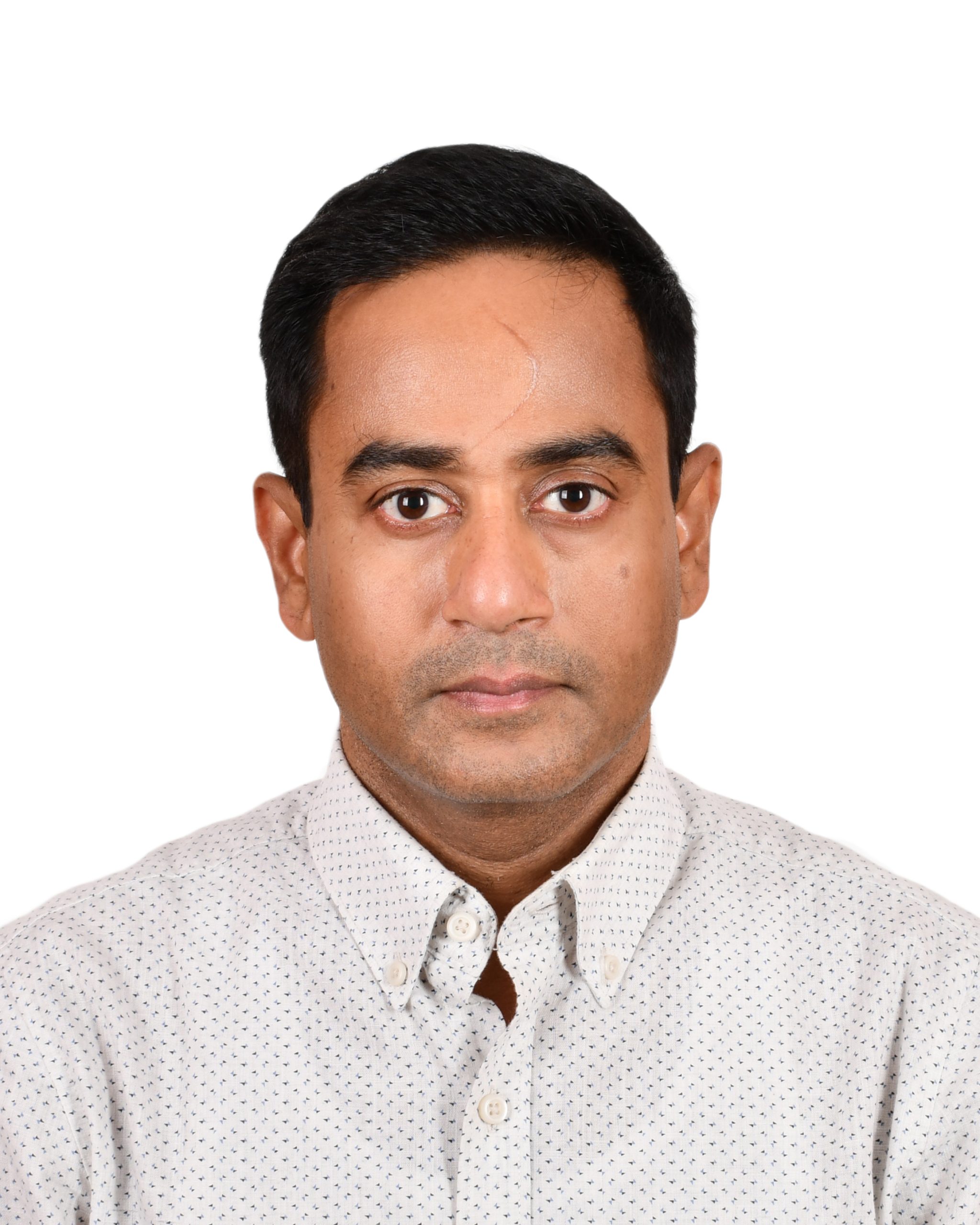 Dr. Sanjeev Routray is an Assistant Professor in the Institute of Asian Studies, Universiti Brunei Darussalam. He completed his PhD in sociology at the University of British Columbia. Dr. Routray is a sociologist-anthropologist, critical urbanist, and migration specialist of South Asia and beyond. His areas of expertise include urban poverty, political and legal mobilizations, transregional migration, and caste and labor market negotiations. He is the author of The Right to be Counted: The Urban Poor and The Politics of Resettlement in Delhi (2022, Stanford University Press) and his articles have appeared in leading journals including International Journal of Urban and Regional Research, Urban Studies, and City: Analysis of Urban Change, Theory, and Action. Dr. Routray has received fellowships from the Urban Studies Foundation (UK), The Foundation for Urban and Regional Studies (UK), Zeit-Stiftung Ebelin und Gerd Bucerius Foundation (Germany), International Development Research Centre (Canada), and the Hari Sharma Foundation for his research and writing.
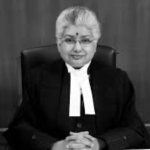 Hon’ble Mrs. Justice B V Nagarathna will deliver the conference closing keynote on the topic ‘Home in the Nation: Indian Women’s Constitutional Imaginaries’. This closing keynote address will be delivered on August 3, 2024, 5 PM, at The Falcon’s Den, Prestige Falcon Tower No. 19, Brunton Road. Hon’ble Justice Bangalore Venkataramiah Nagarathna is a Judge of the Supreme Court of India. She served as a Judge of the Karnataka High Court from 2008 to 2021. She is in line to become the first female Chief Justice of India in 2027. The poster for this session can be accessed
 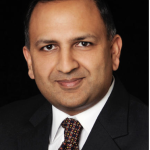 Pratap Bhanu Mehta is the Laurence S. Rockefeller Visiting Professor for Distinguished Teaching at Princeton University. Prof. Pratap Bhanu Mehta will deliver the opening keynote address on August 2, 2024, 9:15 AM, at the NLSIU Training Centre. He was previously Vice-Chancellor of Ashoka University, and President, Centre for Policy Research, Delhi. He has previously taught at Harvard, Ashoka University, Jawaharlal Nehru University and has been Global Faculty at NYU Law School. He has published widely in political theory, history of ideas, Indian constitutional law and politics in India. He is the author of The Burden of Democracy (Penguin 2003) and has produced several edited volumes. He is (most recently) co-editor with Madhav Khosla and Sujit Choudhary of The Oxford Handbook to the Indian Constitution. His forthcoming work looks at philosophical ideas about religion in 20th-century India. The poster for this session can be accessed
  NLSIU’s
  About the speaker
  and author of ‘
 Nivedita Menon is a Professor at the Centre for Comparative Politics and Political Theory, Jawaharlal Nehru University, Delhi. Her latest book is Secularism as Misdirection: Critical Thought from the Global South (Permanent Black and Duke University Press 2023). Apart from research papers in Indian and international journals, her previous books are Seeing like a Feminist(2012/updated 2nd Edition 2022), Recovering Subversion: Feminist Politics Beyond the Law (2004); and (co-written) Power and Contestation: India after 1989 (2007/2nd Edition 2014). She is a regular commentator on contemporary issues on the collective blog kafila.online (of which she is one of the founders). She has translated fiction and non-fiction from Hindi and Malayalam into English, and from Malayalam into Hindi, and received the AK Ramanujan Award for translation instituted by Katha.